The SBC Wants Autonomous Churches — Until They Disagree
The fight over women pastors is really a fight over authority, autonomy, and the future of Baptist identity.
"The same denominational voices that argued the SBC could not intervene to protect women from abuse because of local church autonomy were the very voices arguing the Convention could and should regulate what those same churches called their staff."
By Billy J Bailey
The Southern Baptist Convention’s vote to formalize the exclusion of women from pastoral roles was presented by its supporters as an act of doctrinal clarity. It was, in truth, an act of institutional definition — one that reveals a denomination in the late stages of a decades-long project to transform theological conviction into constitutional control.
I was a Southern Baptist pastor before I wasn’t. The leaving happened the way a tide goes out: gradually, then noticeably, then completely. The Convention I had given myself to was narrowing, and the narrowing was not incidental. It was directional, intentional and, I eventually concluded, telling.
I did not leave the faith. I want to be precise about that, because the SBC’s current trajectory depends, at least in part, on collapsing that distinction. To question the Convention’s direction is not to abandon Scripture. It is to take Scripture seriously enough to disagree.
Just this week, Southern Baptist messengers voted overwhelmingly to advance a constitutional amendment that would formally bar any church affirming women in pastoral roles from participation in the denomination. The amendment requires a second vote before taking effect. The direction, however, is no longer in question. What began as a theological position has become an enforcement mechanism. What began as a matter of contested interpretation has become a test of institutional loyalty. The denomination’s supporters describe it as doctrinal alignment. It is more precisely the culmination of a project years in the making.
To understand what is happening now, it helps to understand how the SBC arrived here. The denomination’s rightward shift on gender and authority did not emerge overnight. It was the product of a sustained, organized effort that began in the late 1970s and accelerated through the 1980s — a period Southern Baptist historians call the Conservative Resurgence. Its architects, led by figures like Paige Patterson and Paul Pressler, were explicit about their aims: to reclaim the denomination’s seminaries, mission boards, and institutional infrastructure from what they characterized as theological drift. They succeeded. Within two decades, they had reshaped the SBC’s leadership from top to bottom.
The Resurgence was, depending on one’s vantage point, either a principled recovery of doctrinal fidelity or a sophisticated political campaign to consolidate power. In practice, it was both. The theological convictions were real and so was the machinery. One of its lasting consequences was a denomination far more comfortable than it had previously been with the idea that institutional belonging required doctrinal uniformity.
In 2000, the SBC revised its foundational confession of faith, the Baptist Faith and Message, to restrict the pastoral office to men. The revision was controversial even then, and not only among theological progressives. Longtime conservative Southern Baptists who held complementarian views nonetheless questioned whether a confession of faith was the right instrument for enforcing them. Confessions, in the Baptist tradition, have historically been understood as statements of shared conviction, not binding creedal tests. The revision blurred that distinction.
Over the years that followed, it evolved from theological conviction into organizational infrastructure. Churches were investigated, credentials were challenged, and congregations were removed from fellowship. When Saddleback Church was disfellowshipped in 2023, the message was unmistakable. No church was too large, too influential, or too historically connected to the denomination to be exempt.
Saddleback is worth pausing on, because its story complicates the narrative the SBC has told about itself. Rick Warren founded Saddleback in 1980 in Lake Forest, California. He is a fourth-generation Southern Baptist whose family roots in the denomination stretch back to the nineteenth century. He is not a theological progressive. He spent decades holding and teaching complementarian views. He changed his position, by his own account, not because of cultural pressure or institutional politics, but because of Scripture.
After COVID prompted Warren to undertake an intensive study of church history and the Great Commission — reading more than two hundred books on the subject — he arrived at a set of passages he said he had never seriously reckoned with before. The process, he has said, was disorienting precisely because it ran against convictions he had held for his entire ministry. Culture did not change him, nor did anecdotes. What changed him, he insists, was a direct confrontation with biblical texts he could no longer read the way he had always read them.
That is not the profile of a man capitulating to the spirit of the age. It is the profile of a pastor doing what Baptists have always said pastors should do: going back to the text. The SBC’s response was to expel his church. The constitutional amendment now advancing is the logical terminus of that progression. It converts exclusion from a practice into a founding principle — inscribed not in a confession that churches affirm voluntarily, but in the denomination’s governing documents themselves.
For the women who find themselves in the amendment’s crosshairs, this is not an abstraction. Thousands of women serving in SBC-affiliated churches have understood their calling in pastoral terms, pursued theological education, counseled families through grief and crisis, preached sermons, and led congregations through ordinary and extraordinary seasons of institutional life. Many of them have done so within churches that hold a high view of Scripture, affirm orthodox theology on every other contested question, and have arrived at their conclusions about women in ministry through rigorous, good-faith engagement with the biblical text.
The amendment’s message to them is unambiguous: your discernment of calling is, by constitutional definition, disqualifying. That is a significant thing to say to a person. It ought to be said, if it is said at all, with some awareness of its weight. It is also worth noting what the amendment says to the churches those women serve. It says that a congregation’s own prayerful process of discernment — its reading of Scripture, its sense of calling, its experience of ministry — is subordinate to a determination made by a national convention. That the local church’s authority over its own affairs extends precisely as far as Nashville permits.
The theological argument animating the amendment is not frivolous. Several Pauline texts restrict women from authoritative teaching roles, and serious scholars have defended complementarian interpretations for generations. I do not dismiss those arguments. I have studied those passages, taught them, and wrestled with them across years of pastoral ministry. I have simply never found them sufficient as a final word.
The passages commonly cited exist within a Scripture that also names Phoebe a deacon, affirms Junia as notable among the apostles, and records Paul declaring that in Christ there is neither male nor female. They exist within a Gospel narrative in which Jesus taught women openly, welcomed them among his closest followers, and made them the first witnesses to the resurrection.
That final point deserves more sustained attention than it typically receives in these debates. The first-century Jewish world into which Jesus ministered had well-established conventions about gender, testimony, and public religious life. Women’s testimony was regarded with suspicion in legal and religious contexts. The disciples’ initial response to the women’s report of the resurrection — dismissed in Luke’s account as idle talk — reflects those cultural assumptions precisely. Jesus knew all of this and he entrusted the announcement anyway.
Whatever conclusions one reaches about church governance, one must reckon with the fact that Christianity’s defining proclamation — the resurrection of Jesus — was first entrusted to women. At the hinge of all history, when the Church’s central message needed to be carried, Christ did not work around them. He commissioned them.
Warren made a related point in the aftermath of Saddleback’s expulsion. Reflecting on the Great Commission’s command to go and teach, he argued that the mandate was addressed without gender restriction — that the same Christ who commissioned women at the tomb issued a commission to his followers that did not exclude them from its scope. It is the kind of argument that does not resolve the debate. It does, however, illustrate that the egalitarian reading is not a concession to contemporary cultural pressure. It is a reading with deep roots in the text itself, one that serious, orthodox, Scripture-committed pastors have arrived at through exactly the kind of rigorous engagement the Baptist tradition has always honored.
Complementarians have responses to these arguments, and some of those responses are thoughtful. The point is not that the egalitarian reading is self-evidently correct. The point is that the question is genuinely contested — that sincere, careful, Scripture-saturated Christians have looked at the same texts and arrived at different conclusions for reasons that deserve more than institutional dismissal. Rick Warren is not an outlier. He is a data point and the SBC’s answer was to remove his church from fellowship.
This amendment treats a disputed interpretive question as though it were a settled doctrinal matter on par with the Trinity or the resurrection itself. Warren put the problem directly: the SBC permits disagreement over the atonement, over election, over eschatology, over the nature of sin. It does not, apparently, permit disagreement over staff titles. That asymmetry requires an explanation the denomination has refused to provide.
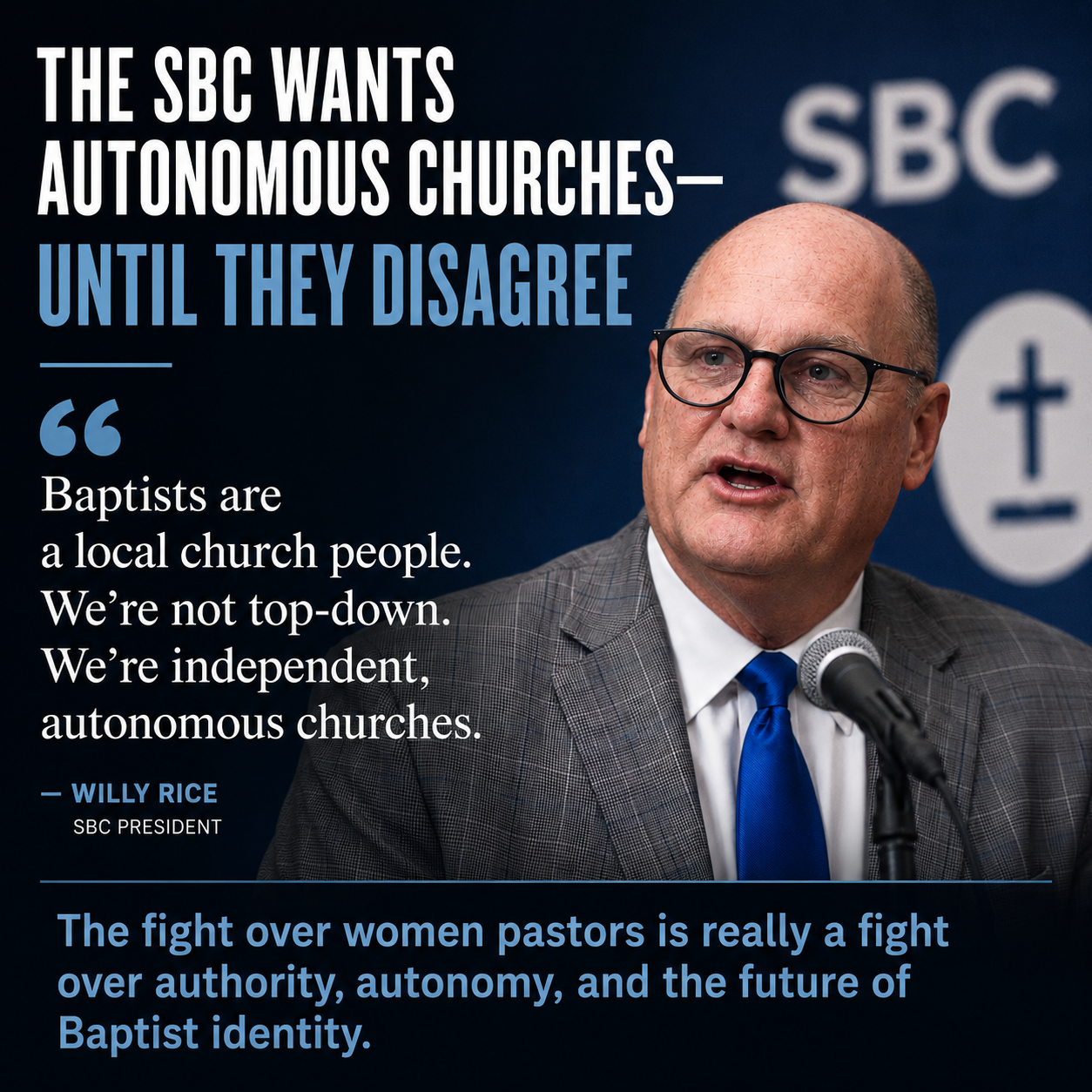
The theological argument, finally, is not what this moment is most fundamentally about. Shortly after his election as SBC president, Willy Rice offered what sounded like a principled defense of the denomination’s ecclesiological identity. “Baptists are a local church people,” he said. “We’re not top-down. We’re not run out of Nashville, Louisville, Wake Forest, Atlanta or anywhere else. We’re independent, autonomous churches.”
It is a statement that captures something genuinely central to Baptist ecclesiology — something that distinguishes the Baptist tradition from episcopal polities like Catholicism and Anglicanism, where authority flows downward from bishops and councils. Baptists have historically insisted that local congregations stand directly under the lordship of Christ, and that no outside body — no convention, no association, no confessional authority — can override that relationship. The principle is not merely procedural. It is theological. It reflects a conviction about the nature of the Church and the sufficiency of Christ’s headship over it. That’s makes the proposed amendment so difficult to reconcile with the rhetoric surrounding it.
Warren identified the contradiction with characteristic directness. The same denominational voices that argued the SBC could not intervene to protect women from abuse — because of local church autonomy — were the very voices arguing the Convention could and should regulate what those same churches called their staff. Autonomy, Warren observed, seemed to apply only when it was convenient. When the question was protecting vulnerable women from predatory leadership, the Convention’s hands were tied by the principle of congregational independence. When the question was preventing women from holding pastoral titles, the Convention’s hands were suddenly free.
That is not a principled application of Baptist ecclesiology. It is a selective one. If churches are truly autonomous, then autonomy necessarily includes the freedom to arrive at different conclusions on disputed questions without forfeiting fellowship. Autonomy that evaporates the moment a church reaches an unapproved conclusion is not autonomy. It is conditional tolerance. The amendment does not expand Baptist autonomy. It limits it. And the limitation is constitutional — meaning permanent, structural, and deliberately so.
This is not a hypothetical concern. The mechanism being built here is not designed for a single application. Constitutional provisions establish precedents. They create frameworks. Once the denomination has enshrined the principle that theological non-conformity on gender warrants constitutional exclusion, the question is not whether that framework will be applied to other questions, but when — and to which ones.
More significantly, the amendment does not strengthen unity. It redefines unity as uniformity. The distinction matters more than it might initially appear, particularly for a tradition that has historically prized voluntary cooperation over coerced conformity. Unity is a commitment to remain in relationship across disagreement. It is costly and often uncomfortable. It requires each party to hold their convictions seriously while extending genuine charity to those who hold different ones. It does not demand agreement on every contested question. It demands enough shared commitment to mission and enough mutual respect to keep working together despite the differences.
Uniformity is agreement imposed as a condition of belonging. It is tidier than unity, which is part of its appeal. It eliminates the friction. It settles the argument by removing the people who represent the other side of it. Baptist history knows the difference. The tradition emerged, in part, from communities that had experienced what happens when religious institutions enforce conformity coercively — when belonging requires not just shared conviction but identical conclusion. The response was not to build a better enforcement mechanism. It was to insist that faith cannot be coerced, that conscience answers to God before it answers to any institution, and that genuine Christian community is built on voluntary association rather than compelled agreement.
Warren, reflecting on his own denominational upbringing, captured something of this when he noted that Southern Baptists have historically described themselves as anticreedal — as a people who hold no creed but Christ and no book but the Bible. That self-description has always carried an implicit acknowledgment: that interpretive diversity is not a bug in the Baptist system — it is a feature and the natural consequence of placing Scripture in the hands of local congregations and trusting them to read it under the Spirit’s guidance.
What the Convention is increasingly pursuing is not congregational autonomy but its conceptual opposite: a form of heteronomy, in which authority is imposed from outside the local congregation, defining the outer boundaries of acceptable interpretation and enforcing them constitutionally. Churches remain free to govern themselves. They simply must govern themselves within an ever-narrowing corridor of permissible conclusions. That is not the Baptist tradition. It is a departure from it wearing the tradition’s vocabulary.
None of this means the Convention lacks the right to define its convictions. Every institution must decide what it believes. A church body that stands for nothing coherent eventually loses its capacity to stand for anything at all. Institutional identity requires some capacity to say what falls outside it. But there is a meaningful difference between holding a theological position and constitutionally purging those who hold a different one. Between teaching complementarianism as the denomination’s conviction and writing egalitarians out of fellowship as a matter of governing principle. Between saying “we believe this” and saying “you may not belong.”
The first can be an act of conviction. The second is an act of control. Institutions that become increasingly organized around boundary enforcement often find, in time, that the boundaries have become the identity. The machinery of exclusion begins to consume more energy than the mission it was designed to protect. The question of who does not belong crowds out the question of what the institution exists to do.
The SBC has spent years confronting declining membership, declining baptisms, and declining cultural reach. Those trends predate the current controversy and have multiple causes. But one factor is difficult to ignore: the Convention’s internal battles have become more visible than its mission. The news cycle generated by disfellowshipping decisions, constitutional amendments, and credential reviews does not communicate the Gospel. It communicates an institution increasingly preoccupied with its own boundaries.
Saddleback Church, under Warren’s leadership, baptized tens of thousands of people and became a model for church growth studied across the evangelical world. Its expulsion did not make the SBC more effective at its mission. It made the denomination smaller, and it made the denomination’s priorities legible to anyone paying attention. The SBC was willing to lose one of its most fruitful congregations rather than tolerate a disagreement over pastoral titles. That is a revealing institutional choice. It reveals what, in the end, the institution values most. A denomination that leads with exclusion will attract people drawn to exclusion. That is a self-selecting dynamic with predictable long-term consequences.
There is an alternative. It is less tidy, and it requires something that institutional anxiety tends to resist: confidence. It would mean teaching complementarian convictions robustly in the churches and seminaries that hold them, making the theological case with rigor and care, and trusting that a well-made argument can commend itself without being propped up by constitutional enforcement. It would mean extending fellowship to churches that arrive at different conclusions on genuinely contested questions — not because those conclusions don’t matter, but because the mission matters more, and because the Baptist tradition has always held that conscience is answerable to God before it is answerable to any convention.
It would mean distinguishing between questions that are genuinely constitutive of Christian orthodoxy and questions that, however important, represent contested interpretation of disputed texts. The resurrection is the first kind of question. The precise application of a handful of Pauline passages to contemporary church governance structures is not. Warren made this point with blunt clarity: the SBC tolerates disagreement over the atonement, over election, over eschatology. The suggestion that staff titles represent a more fundamental doctrinal commitment than any of those questions does not survive scrutiny.
That approach requires living with tension rather than eliminating the people who represent it. It requires trusting that the Gospel is strong enough to survive disagreement, that the mission is compelling enough to hold together people who read some texts differently, and that genuine unity has always required exactly that kind of patience. I now serve in a non-denominational context. The theological table is wider. The questions are more openly held. I did not arrive there by abandoning conviction. I arrived there because I watched a particular institution confuse conviction with control, and mistake, with increasing confidence, uniformity for unity.
Rick Warren, for his part, did not leave quietly. He spent years trying to make the case from within, appealing to the same tradition he had given his life to, arguing in the same biblical register the denomination had always claimed to prize. He was not heard. He was expelled.
The Southern Baptist Convention is not facing a crisis of doctrine. It is facing a crisis of identity. The question before its messengers is no longer whether women may serve as pastors. The Convention has largely settled that question for itself, and the second constitutional vote is unlikely to reverse the trajectory. The deeper question is what kind of institution the SBC intends to be in the years that follow.
Whether a movement built on congregational freedom still trusts its own churches enough to tolerate disagreement. Whether it will define itself by the strength of its center or the tightness of its perimeter. Whether Baptist autonomy remains a living ecclesiological principle or has become a rhetorical relic, invoked at annual meetings and quietly dismantled between them. Whether the denomination’s energy will flow toward its mission or toward the management of its own internal boundaries.
Those are not, finally, questions about women in ministry. They are questions about authority, about what kind of institution the SBC is building, and what it will look like when the building is finished. They are questions about autonomy. About whether the Baptist commitment to congregational self-governance means anything when the governing produces an unwelcome result — or whether, as Warren suggested, autonomy is simply a principle the denomination invokes when it is useful and sets aside when it is not. They are also questions about identity. About what it means to be Baptist at all — whether that identity is defined by a set of shared convictions held freely and voluntarily, or by a set of enforced conclusions from which no deviation is constitutionally permitted.
Those questions will outlast this amendment. They will outlast the current denominational leadership. They may, if they go unanswered long enough, outlast the Convention itself. The SBC has survived controversy before. It has navigated schism, scandal, and structural crisis. It is a resilient institution with deep roots and genuine conviction at its core. But resilience is not the same as health. And an institution can be too focused on its own survival to ask whether what it is surviving toward is worth the cost.