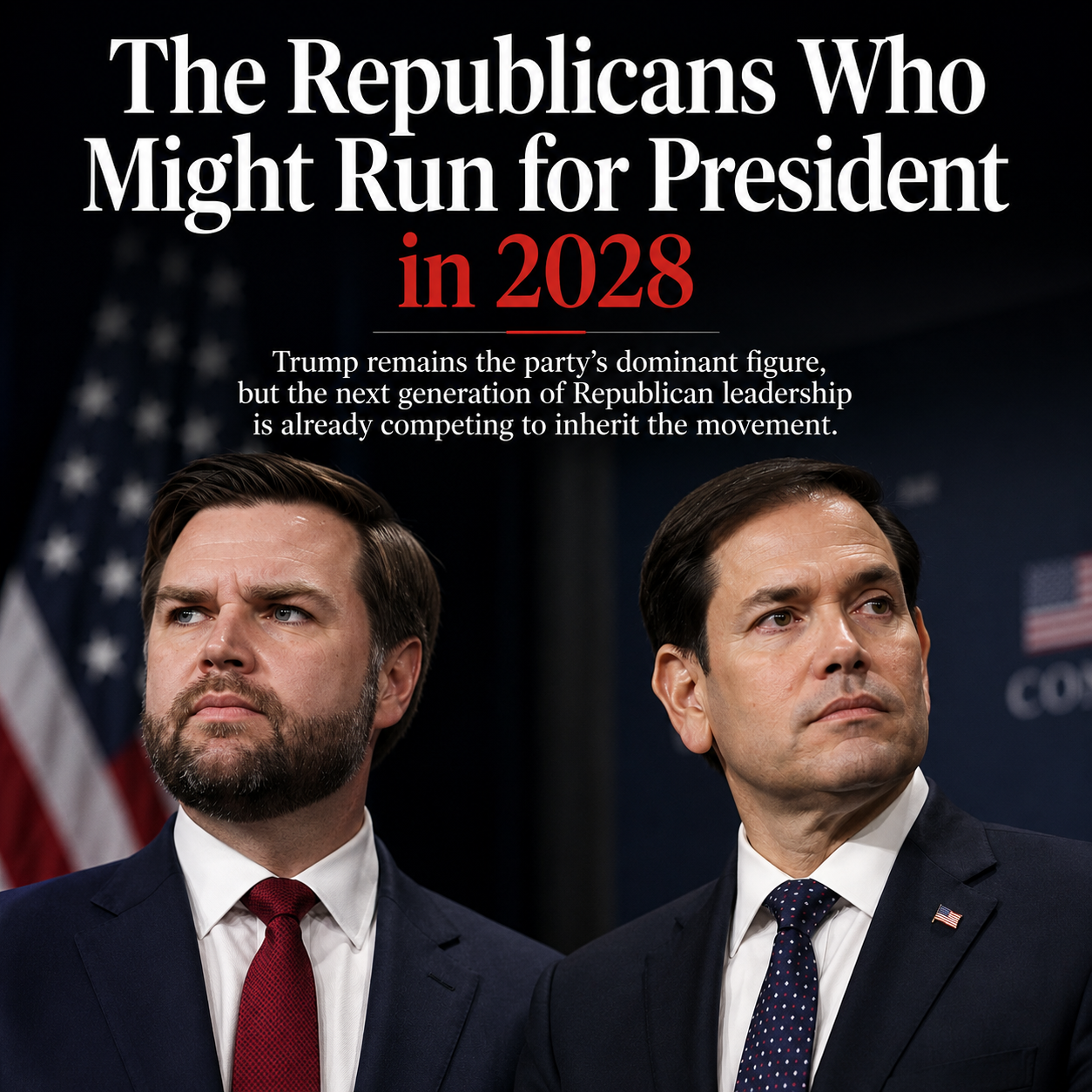
The Republicans Who Might Run for President in 2028
Trump remains the party's dominant figure, but the next generation of Republican leadership is already competing to inherit the movement.
The Republican Party will almost certainly enter the 2028 cycle with a deep bench of potential contenders. Some of these figures are already positioning themselves for national campaigns, while others appear regularly in early conversations about the party's future leadership.
By Billy J Bailey
The 2028 presidential race hasn’t officially started.
There are no campaign rallies, no debate stages, and no early primary maps lighting up cable news.
But if you watch carefully, the positioning has already begun. Governors are building national brands. Senators are sharpening their messages. Political figures who have spent the past decade in the national spotlight are quietly deciding whether their moment has arrived.
The Republican Party will almost certainly enter the 2028 cycle with a deep bench of potential contenders. Some of these figures are already positioning themselves for national campaigns, while others appear regularly in early conversations about the party’s future leadership.
The following names are the Republicans most frequently mentioned in early conversations about the 2028 presidential race. Some have already tested the national stage through previous campaigns, while others have built growing influence as governors, senators, or national figures within the party. None have formally declared a campaign, of course — but their visibility, networks, and political positioning suggest they would be among the most plausible contenders if the race opened tomorrow.
Vice President J.D. Vance occupies one of the most strategically powerful positions in American politics as the sitting second-in-command during Donald Trump’s second administration. After serving briefly as a U.S. Senator from Ohio, Vance rose rapidly to national prominence as Trump’s running mate in the 2024 election and was sworn in as vice president in January 2025. His role in shaping the administration’s message and policy agenda has made him a natural early frontrunner in discussions about the Republican Party’s 2028 presidential field.
His liabilities stem largely from the same proximity to power that gives him an advantage. Sitting vice presidents often struggle to define their own political identity separate from the president they serve, particularly when the administration faces political turbulence. If Vance were to run in 2028, he would likely face the challenge of stepping out from Trump’s shadow while still maintaining the support of the coalition that helped elect the ticket.
Ron DeSantis has emerged as one of the Republican Party’s most prominent figures during his tenure as governor of Florida. His aggressive policy agenda, willingness to engage in cultural and political fights, and strong fundraising network made him a natural presidential contender. During the 2024 Republican primary, he entered the race with high expectations and significant support from donors and conservative activists. Early polling at the time frequently placed him among the leading contenders for the nomination.
His liabilities, however, became apparent during that same campaign. Critics argued that his political style struggled to connect with voters in unscripted settings, and his campaign infrastructure faced several internal challenges. If he chooses to run again in 2028, he would need to demonstrate not only political discipline but also an ability to expand his appeal beyond his existing base.
Former Virginia Governor Glenn Youngkin gained national attention after winning a competitive gubernatorial race in a politically divided state. His ability to appeal to suburban voters while maintaining support from conservative grassroots activists positioned him as a potentially unifying figure within the Republican Party. That combination has made him an attractive option for Republicans who believe the party’s path to the White House runs through swing-state suburbs.
His liabilities, however, may lie in questions about the durability of that coalition. When his lieutenant governor, Winsome Sears, ran to succeed him, she lost the race by a margin of 58% to 42%, raising questions about whether the political formula that worked for Youngkin himself can be replicated nationally. A presidential campaign would require him to demonstrate that his brand of conservatism can translate beyond a single successful election and resonate nationally.
Nikki Haley has already tested the waters of presidential politics. As a former governor of South Carolina and U.S. Ambassador to the United Nations, she entered the 2024 Republican primary with substantial experience in both domestic governance and international diplomacy. Although the race was dominated from the beginning by Donald Trump, Haley remained in the contest longer than most challengers, ultimately winning the Republican primary in Vermont and accumulating more than four million votes nationwide, finishing with just under 20% of the popular vote in the primary contest.
Haley’s liabilities are tied closely to the political tensions that emerged during that campaign. Trump frequently branded Haley a “RINO” on the campaign trail, a label that carries significant weight within portions of the Republican base. Whether fair or not, that characterization could follow her into a future primary. If the party remains strongly aligned with Trump’s political movement heading into 2028, Haley could face the challenge of convincing voters that she represents continuity with the party’s priorities rather than a departure from them.
Georgia Governor Brian Kemp strengthened his national reputation after winning reelection in one of the country’s most closely watched battleground states. His ability to maintain strong support among Republican voters while also winning statewide in a politically competitive environment has made him an appealing figure for strategists who believe the party’s path to the White House runs through states like Georgia, Arizona, and Wisconsin. That reputation was evident when national Republicans aggressively tried to recruit him to challenge Democratic Senator Jon Ossoff in the 2026 midterm elections. Kemp ultimately declined the opportunity, a decision many observers interpreted as a signal that his political ambitions may lie on a larger national stage.
His relationship with Donald Trump, however, has been complicated. After the 2020 election, Trump openly criticized Kemp and even encouraged a primary challenge against him by Former Senator David Perdue during Kemp’s 2022 reelection campaign. Kemp ultimately defeated Perdue decisively, strengthening his standing as an independent political force within the party. Still, that history highlights a potential liability in a presidential primary: navigating a party where Trump remains highly influential while maintaining the independent political brand that helped him win in Georgia.
Arkansas Senator Tom Cotton has long been considered a potential presidential contender, particularly among Republicans who prioritize national security and a muscular foreign policy. A Harvard-educated Army Veteran who served in both Iraq and Afghanistan, Cotton has built his political reputation around strong defense spending, a confrontational posture toward geopolitical rivals such as China and Iran, and an emphasis on projecting American strength abroad. Within Republican policy circles, he is widely viewed as one of the party’s most consistent voices on national defense and strategic competition.
That same reputation could also present a political liability in a presidential race. After decades of prolonged military engagements overseas, many voters across the political spectrum have shown growing fatigue with interventionist foreign policy. If the national mood in 2028 leans toward lowering global tensions and prioritizing domestic stability, Cotton’s hawkish posture could be viewed by some voters as a return to an era of confrontational international politics. In a primary environment where candidates often compete to reflect the public’s appetite for restraint and peace, that perception could complicate his path to broader support.
Entrepreneur Vivek Ramaswamy entered national politics as an outsider voice during the 2024 Republican presidential primaries, building recognition through an energetic campaign style and a willingness to challenge both parties’ political establishments. Although he ultimately secured only about 0.4% of the popular vote — fewer than 100,000 votes nationwide, his media presence and policy messaging gave him a national profile that many first-time candidates struggle to achieve. He is now attempting to translate that visibility into electoral success by running for governor of Ohio, where he currently leads the Republican primary field and, in early general election polling, holds a narrow polling advantage of roughly one percentage point over the leading Democratic contender.
That race could dramatically shape his future political trajectory. If Ramaswamy wins the Governorship, it would immediately elevate his credibility as an elected executive and strengthen his standing within the Republican Party. At the same time, it could complicate the timing of a presidential bid, as he would have won his first elected office only about two years before the 2028 General Election, leaving limited time to build a governing record before launching a second national campaign. Conversely, a loss in either the primary or the general election could significantly weaken his prospects for higher office, making the Ohio race a pivotal moment in determining whether his political career expands — or stalls.
Kristi Noem’s national profile expanded significantly when she was confirmed as Secretary of Homeland Security in 2025 after serving as governor of South Dakota. The Senate approved her nomination in a tightly divided vote that ultimately required the vice president to cast a tie-breaking vote. That appointment placed Noem at the center of some of the most consequential national debates surrounding immigration, border security, and federal law enforcement, instantly elevating her from a regional executive to a nationally recognized political figure.
Her tenure at DHS also introduced significant political liabilities. The position placed her squarely in the middle of intensely polarized policy battles, and she was eventually removed from the role, with Oklahoma Senator Markwayne Mullin nominated to replace her, though his confirmation remains pending. Supporters would likely argue that her experience running one of the federal government’s largest and most politically fraught departments demonstrates executive readiness for higher office. Critics, however, would likely point to the controversies surrounding that tenure as evidence that a national campaign would face immediate scrutiny.
Presidential primaries often include candidates who are expected — and occasionally a few who challenge the direction of the party itself. The figures in this section may not be the most likely to enter the race, but each represents a leadership style, governing philosophy, or political coalition that could shape the Republican Party’s future. Whether they choose to run or not, their presence in a primary would almost certainly change the conversation.
Former Wyoming Representative Liz Cheney became one of the most prominent Republican critics of Donald Trump, particularly through her role on the House January 6 Committee and her outspoken defense of constitutional norms and institutional stability. Over time, Cheney has positioned herself as a leading voice for a more traditional brand of conservatism rooted in national security, rule-of-law principles, and democratic institutions. For Republicans concerned about the long-term direction of the party, Cheney represents a clear and unapologetic alternative vision of Republican leadership.
Her liabilities within a Republican primary are equally clear. During the 2024 general election, Cheney endorsed Democratic Presidential Nominee Kamala Harris and participated in a series of “Country over Party” rallies advocating for Harris’s victory. While Cheney framed the endorsement as a defense of democratic institutions rather than a partisan shift, many Republican voters viewed the move as a betrayal of party loyalty. If the Republican electorate remains strongly aligned with Trump’s political movement heading into 2028, that endorsement could become one of the most significant obstacles to any potential presidential campaign she might pursue.
Former Maryland Governor Larry Hogan built a reputation as a pragmatic Republican capable of winning in one of the most heavily Democratic states in the country. During his tenure, he emphasized fiscal responsibility, infrastructure investment, and a willingness to work across party lines, earning relatively strong approval ratings even among voters who did not typically support Republican candidates. That record has led some strategists to view Hogan as a potential figure capable of appealing to moderates and independents in a national election.
His challenge within a Republican primary, however, is rooted in his relationship with the party’s most polarized political moments. During the 2024 presidential election, Hogan publicly stated that he would vote for neither Former Republican President Donald Trump nor current Democratic Vice President Kamala Harris. While he framed the decision as a reflection of his frustration with the choices presented to voters, many Republican activists interpreted it as a refusal to support the party’s nominee. In a primary environment where loyalty to the party’s leadership often carries significant weight, that decision could remain a lingering liability.
Former New Hampshire Governor Chris Sununu has built a reputation for pragmatic leadership and consistent electoral success in a politically competitive state. His approachable governing style and willingness to work across party lines have helped him maintain strong approval ratings while navigating the complex political landscape of New England. Sununu also comes from a well-known political family in New Hampshire. His father, John H. Sununu, previously served as governor, and his brother, John E. Sununu, served as a U.S. Senator and is now seeking reelection to that seat in November 2026.
That family legacy could become a meaningful political advantage. If his brother succeeds in returning to the Senate in 2026, the Sununu name could once again dominate New Hampshire politics — an important factor given the state’s status as one of the earliest and most influential presidential primary contests. At the same time, Sununu’s moderate tone and bipartisan reputation may present challenges in a Republican primary environment where many voters prefer candidates who take sharper ideological positions.
Marco Rubio has spent more than a decade as one of the Republican Party’s most visible national figures. After serving in the U.S. Senate for years, he now serves as U.S. Secretary of State, placing him at the center of American foreign policy and diplomacy. Rubio is also no stranger to presidential politics. During the 2016 Republican primaries, he won three states, earned more than 3.5 million votes, and captured over 11% of the popular vote, briefly emerging as one of the party’s most prominent next-generation leaders. His experience on the global stage and long-standing focus on international affairs continue to make him a recognizable voice in Republican policy circles.
At the same time, Rubio’s political path carries some potential challenges. His first presidential campaign unfolded during a period when the Republican Party was undergoing a major shift in tone and priorities, and that transformation has continued in the years since. Serving as Secretary of State may elevate his national stature, but it also ties his reputation closely to the administration’s foreign policy outcomes. If Rubio were to consider another presidential run, he would need to demonstrate that his leadership style and policy vision align with the current direction of the Republican electorate.
American presidential politics has a long history of producing candidates who were not initially part of the expected field. Occasionally, a respected national figure, a former cabinet official, or a leader from outside traditional politics emerges and reshapes the race. If a surprise contender were to appear in 2028, it could look something like this.
Former Ohio Governor John Kasich represents a potential wild card with significant national political experience. During the 2016 Republican presidential primaries, Kasich positioned himself as one of Donald Trump’s most outspoken critics within the party. He ultimately won the battleground state of Ohio, accumulated more than 4 million votes nationwide, and captured nearly 14% of the Republican primary vote, demonstrating meaningful support among voters looking for an alternative to the party’s emerging populist direction.
Kasich’s liabilities, however, are closely tied to his willingness to cross party lines in recent elections. In 2020, he appeared at the Democratic National Convention and publicly endorsed Joe Biden, arguing that country should come before party loyalty. While Kasich framed the move as a defense of democratic norms and bipartisan cooperation, many Republican voters viewed it as a break with the party. In a Republican primary environment that remains heavily influenced by Trump-era politics, that history could make a national comeback difficult — though not impossible.
Few figures in modern Republican politics possess the international stature of Former Secretary of State Condoleezza Rice. A scholar, diplomat, and former national security advisor, Rice played a central role in shaping U.S. foreign policy during the early 2000s and remains widely respected for her intellect and leadership experience. Her public reputation has long reflected that stature. In 2006, 45% of voters described her as the most powerful woman in the United States, and during the 2012 presidential election, more than 30% of Republican voters said they hoped Mitt Romney would select her as his running mate. Even decades after leaving office, Rice still maintains a national favorability rating above 36% as of 2026, reflecting a level of cross-generational recognition few potential candidates possess.
At the same time, Rice has shown little interest in pursuing elected office, which remains the largest obstacle to any potential candidacy. Her career has largely unfolded in academia and diplomacy rather than electoral politics, leaving her without the campaign infrastructure typically required for a modern presidential run. She has also expressed more moderate or liberal positions on certain social issues than many Republican primary voters prefer, including support for abortion rights in some circumstances and a more Libertarian view of government’s role in personal decisions. In a Republican primary electorate that often prioritizes strong social conservatism, those positions could present a political liability even for a candidate with Rice’s extensive foreign policy credentials and national stature.
Modern presidential elections are rarely decided by ideology alone. They are shaped by coalition-building, geographic strength in key states, and a candidate’s ability to navigate a polarized media environment. The figures listed here represent different theories of how Republicans might attempt to win a national election in 2028.
These rankings are inherently speculative. Political fortunes rise and fall quickly, unexpected candidates emerge, and events that have not yet occurred often reshape entire elections. Still, examining potential contenders through the lens of general election viability offers a different perspective than the one typically applied to primary contests.
This ranking considers several variables: national name recognition, governing experience, electoral track record in competitive states, favorability among independent voters, and the ability to mitigate political liabilities in a national campaign. This is not a prediction of who will win the Republican nomination, but an early assessment of which figures appear best positioned to compete in a national general election if nominated.
With those considerations in mind, the early landscape might look something like this:
1. Brian Kemp
Kemp ranks first largely because of his demonstrated ability to win statewide in Georgia, one of the country’s most consequential battleground states. His victories there suggest he can assemble the kind of coalition — conservative voters combined with suburban moderates — that often determines presidential outcomes. Unlike some national figures, Kemp has proven electability in competitive territory rather than deeply partisan states. For Republicans focused on reclaiming swing states, that résumé carries significant weight.
2. Glenn Youngkin
Youngkin’s appeal comes from a political style that balances conservative messaging with a tone that resonates with suburban voters. His victory in Virginia demonstrated that Republicans can still win in politically competitive environments with the right coalition. Many party strategists see his approach as a potential blueprint for rebuilding support in suburban regions that have trended away from Republicans in recent years. In a General Election, that coalition-building ability could prove valuable.
3. Condoleezza Rice
Rice’s potential strength lies in her stature and credibility rather than electoral experience. As a former Secretary of State and National Security Advisor, she possesses one of the most formidable foreign policy résumés in modern Republican politics. Her reputation as a thoughtful and measured public figure could appeal to independent voters seeking stability and experience in national leadership. In a General Election environment, that gravitas could make her a surprisingly competitive candidate.
4. Nikki Haley
Haley combines executive leadership as Governor with international diplomatic experience as U.N. Ambassador. Her 2024 presidential campaign demonstrated that she can attract millions of voters nationwide and sustain a national campaign. Haley’s ability to communicate across multiple wings of the Republican coalition could make her a formidable General Election candidate. Her challenge would be navigating lingering tensions from the 2024 primary contest.
5. Chris Sununu
Sununu’s consistent electoral success in New Hampshire reflects a political style that resonates with independent voters. In an era where national elections are often decided by voters outside traditional party bases, that crossover appeal could prove valuable. His pragmatic governing style and relatively moderate tone may also appeal to voters seeking less partisan leadership. However, that same moderation could complicate his path within the broader Republican coalition.
6. Marco Rubio
Rubio’s role as Secretary of State places him at the center of American diplomacy and reinforces his reputation as a serious foreign policy voice. His previous presidential campaign demonstrated his ability to compete nationally, winning several states and securing millions of votes. Rubio also benefits from strong name recognition and a long-standing presence in national politics. A future campaign would depend on how well his leadership style aligns with the evolving priorities of Republican voters.
7. J.D. Vance
As Vice President, Vance holds one of the most influential positions in American politics. That visibility alone would make him a major contender in any national election. However, his close association with the Trump administration could both energize the Republican base and complicate efforts to broaden his appeal among independent voters. Much of his General Election viability would depend on the public perception of the administration in which he serves.
8. Ron DeSantis
DeSantis remains one of the most recognizable figures in modern conservative politics. His tenure as Governor of Florida built a strong national following and demonstrated his ability to mobilize Republican voters. However, his political style has sometimes polarized voters beyond the party’s base. A successful General Election campaign would require expanding that appeal to moderates and independents.
9. Larry Hogan
Hogan’s ability to win two terms as Governor in heavily Democratic Maryland suggests significant crossover appeal. That kind of bipartisan support is often valuable in a national election environment. However, his moderate reputation could make energizing the Republican base more difficult. In a polarized political landscape, turnout challenges could complicate his path.
10. Tom Cotton
Cotton’s military service and focus on national security give him strong credibility on defense and foreign policy issues. In times of global instability, that experience can resonate with voters. However, his hawkish reputation may feel out of step with voters who increasingly favor a more restrained foreign policy after decades of international conflict. That dynamic could complicate his appeal in a General Election.
11. Vivek Ramaswamy
Ramaswamy has built significant national visibility despite having very limited electoral experience. His outsider message and media presence have given him a platform that many first-time candidates struggle to achieve. However, until he demonstrates success in winning and governing elected office, his General Election viability remains unknown. Much of his political trajectory may hinge on the outcome of the Ohio Gubernatorial race this fall.
12. Kristi Noem
Noem’s tenure as Secretary of Homeland Security elevated her national profile and placed her at the center of major policy debates. That experience gives her executive credentials that many candidates lack. However, the controversies surrounding her tenure could complicate efforts to broaden her appeal beyond the Republican base. A General Election campaign would likely face significant scrutiny.
13. John Kasich
Kasich demonstrated meaningful national support during the 2016 Republican primaries, winning Ohio and collecting millions of votes nationwide. His pragmatic style and bipartisan tone could appeal to independent voters. However, his endorsement of Joe Biden in 2020 significantly complicated his relationship with many Republican voters. Rebuilding trust within the party could prove difficult.
14. Liz Cheney
Cheney’s emphasis on constitutional principles and democratic institutions has earned respect from some voters across the political spectrum. However, her endorsement of Kamala Harris in the 2024 election would likely make consolidating Republican support extremely difficult. Even in a General Election environment, that divide would present a major political obstacle. For that reason, her path to national viability remains narrow.
At this stage in the political cycle, history suggests the eventual nominee may not even appear on this list. Early conversations about presidential politics rarely begin with certainty — they begin with the names that seem most plausible before the race truly begins.
Some candidates will seek to emphasize continuity with the political movement that reshaped the party over the past decade. Others may attempt to chart a different course. For now, the campaigns have not begun, but the quiet race for 2028 has already started. Power rankings this early are less about prediction than conversation. The real question is which names belong on this list — and which ones don’t.