The New Arms Race
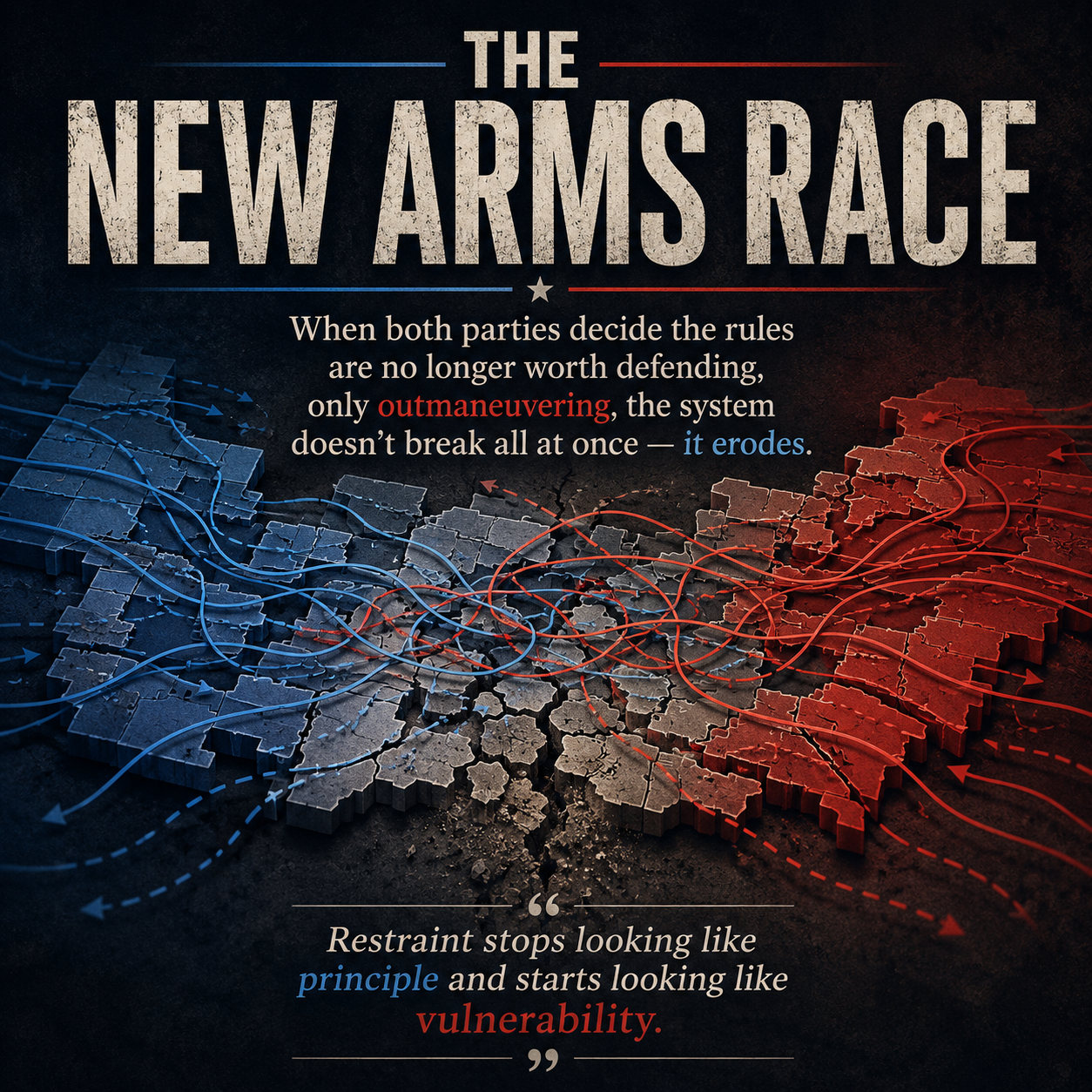
When both parties decide the rules are no longer worth defending, only outmaneuvering, the system doesn’t break all at once — it erodes.
"What was once a debate about democratic ideals is now a debate about competitive strategy."
By Billy J Bailey
There are moments when a theoretical question becomes an operational one. The long-running argument over how American elections are drawn, administered, and ultimately trusted has entered one of those moments. What was once a debate about democratic ideals is now a debate about competitive strategy. And the competition, increasingly, looks like escalation.
For years, reformers across the political spectrum have pointed toward what seemed like a cleaner path: independent commissions, algorithmic models, or so-called “blind” systems that prioritize geometric fairness over political advantage. The premise is straightforward. Districts should be compact, contiguous, and drawn without regard to which party benefits. Strip away the human temptation to tilt the field, the argument goes, and you restore something closer to representative democracy. In practice, it has always run into a more complicated reality. Power, once held, is rarely surrendered voluntarily. And now, the terms of the debate have shifted again.
Rather than debating whether nonpartisan systems should exist, both major parties appear increasingly willing to sidestep them altogether when control is within reach. The result is less a philosophical disagreement and more a strategic escalation. Not an arms race of weapons, but of maps.
The latest flashpoint began when Donald Trump urged Texas Republicans to revisit and redraw congressional districts ahead of schedule. The logic was familiar, even if the timing was not. If demographic shifts or political momentum create an opening, waiting for the next census can feel less like patience and more like negligence. Redistricting, once a decennial ritual tied to population data, becomes instead a flexible instrument of power, deployable whenever the math is favorable.
What followed was predictable, though no less consequential for being so. In California, Governor Gavin Newsom decided to respond in kind. The language of the moment shifted subtly but significantly. What begins as a defense against partisan overreach quickly starts to mirror the very tactics it claims to counter. In this environment, defense and offense are increasingly difficult to tell apart.
This is where the concept of a nonpartisan system begins to erode, not because the idea lacks merit, but because its survival depends entirely on mutual restraint. A geometry-based, politically blind approach to redistricting only functions if both sides agree to honor the same framework. Once one party deviates, the incentive structure changes for everyone else. Restraint stops looking like principle and starts looking like vulnerability. The logic of unilateral disarmament takes hold, and from there the escalation becomes self-sustaining.
The ripple effects are already visible. In Virginia, a redistricting-related measure passed just last night by the narrowest of margins, barely clearing 50 percent. That outcome, while technically decisive, underscores a deeper erosion of confidence. Voters are no longer simply evaluating the mechanics of how districts are drawn. They are trying to anticipate who benefits, and whether any version of the process can still be trusted to produce a legitimate result.
Historically, gerrymandering has been treated as a partisan vice, something one party pursues more aggressively than the other at any given moment, subject to correction when the political winds change. The emerging pattern suggests something more durable and considerably harder to address.
Gerrymandering is becoming systemic. The relevant question is no longer which party engages in it, but whether either party feels it can afford not to. That distinction matters enormously. A partisan problem can, in theory, be corrected by electoral shifts. A systemic one becomes self-reinforcing, written into the structure rather than dependent on the choices of any particular leadership.
The practice itself has also grown considerably more sophisticated. The older model relied on crude but effective tactics: packing opposition voters into a small number of districts, or cracking them across several to dilute their influence. Today’s approach is informed by granular data and predictive modeling with a precision that older mapmakers could not have imagined. These maps are not drawn in ignorance of political geography. They are drawn in precise, calculated response to it.
That contrast with the “blind” systems reformers advocate is not incidental. It is the central tension of this moment. Geometry offers fairness in form. Geopolitics offers advantage in function. The two are rarely aligned, and in a competitive environment, function tends to win.
What makes this moment distinct is not simply that gerrymandering continues. It is that the justification for it is evolving in ways that make it considerably harder to challenge. Increasingly, aggressive redistricting is framed not as an offensive act but as a defensive one. If the other side is doing it, the argument goes, declining to respond is tantamount to surrendering the field. In that framing, the erosion of nonpartisan standards is not a failure of values but a rational response to a broken system. And a broken system, once accepted as the premise, becomes remarkably easy to exploit.
There is also a broader dimension that tends to get lost in the tactical back-and-forth. Redistricting is not only about partisan advantage. It shapes representation directly. It determines which communities have a meaningful voice in Congress and which are sorted into districts designed to minimize their influence. When maps are drawn with precision to achieve political ends, the risk is not only that elections become less competitive. It is that the relationship between voters and their representatives becomes less authentic, and that the government produced by those elections carries less legitimacy as a result.
The question, at this point, is not whether redistricting will remain political. It always has been, and no version of the process is entirely free from human judgment. The question is whether there is still space for a shared standard, however imperfect, that both sides are willing to uphold. Without that baseline of good faith, even the most carefully designed nonpartisan systems become fragile.
The emerging arms race offers a sobering answer. When power is perceived to be at stake, the incentive to optimize the map tends to outweigh the commitment to neutral principles. Each move invites a counter. Each justification reinforces the next. Over time, the system does not collapse. It adapts, not toward fairness, but toward a kind of equilibrium through escalation.
It is a stable outcome, in a narrow sense: Both sides maneuver, both sides rationalize, and the cycle continues. But stability is not the same as legitimacy. And legitimacy, once questioned, is far harder to redraw than any map.