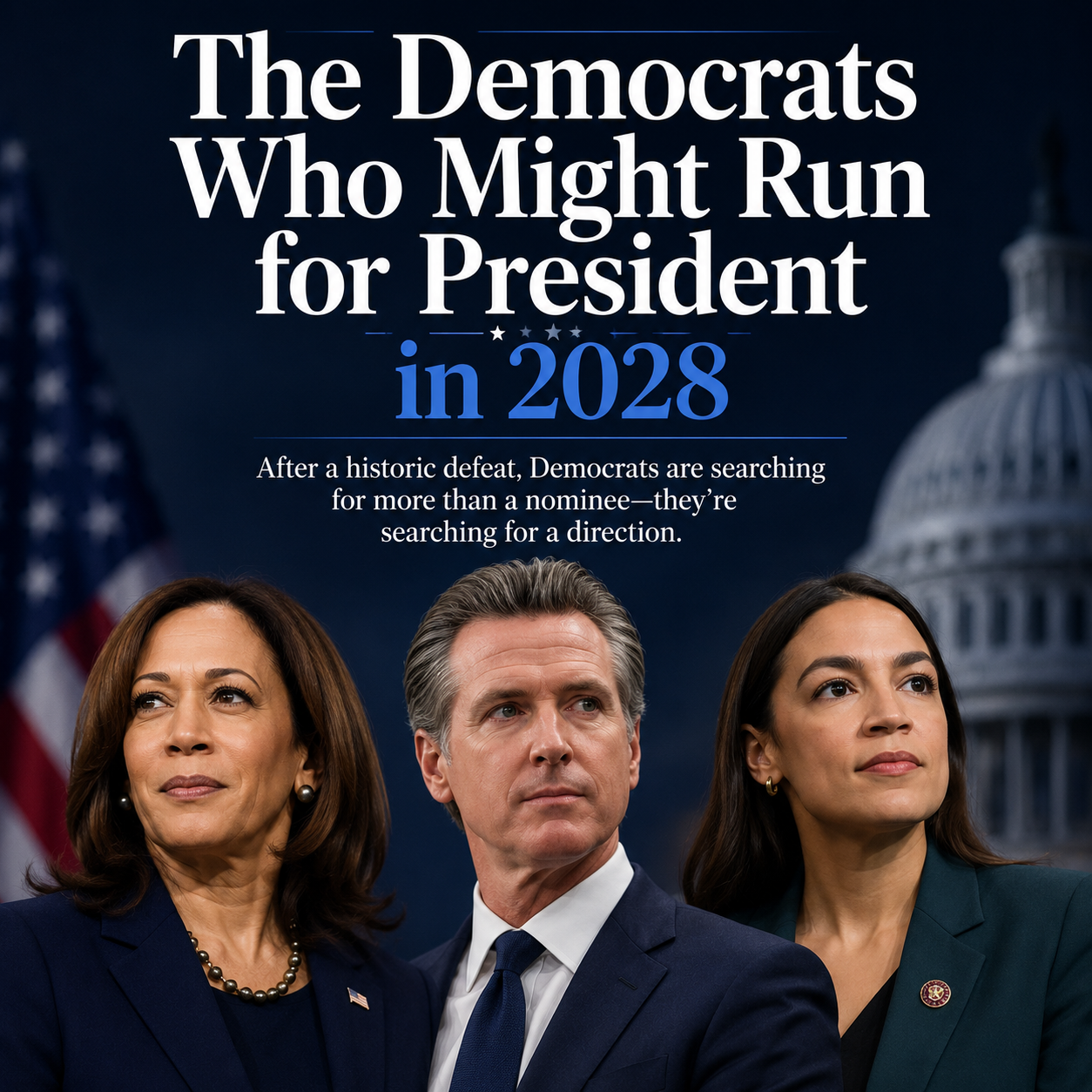
The Democrats Who Might Run for President in 2028
After a historic defeat, Democrats are searching for more than a nominee—they're searching for a direction.
"After losing the White House, both chambers of Congress, and watching the Supreme Court move firmly to the right, the party faces a familiar challenge: deciding whether its future lies in doubling down or changing course."
By Billy J Bailey
The 2028 presidential race has not officially begun. There are no campaign rallies yet, no debate stages, and no early primary maps lighting up cable news. But in American politics, the maneuvering for the next presidential contest almost always begins long before the public notices. Potential candidates begin testing messages, expanding national networks, and quietly assessing whether their moment in national politics may be approaching.
For Democrats, the next presidential cycle will unfold under unusual circumstances. The party entered 2025 after losing control of the White House, the House of Representatives, and the Senate in the 2024 election, while also facing a firmly conservative majority on the Supreme Court. Defeats of that scale rarely leave a party unchanged. It forces a period of reflection about leadership, message, and strategy, and often opens the door for a new generation of national figures to emerge.
The 2026 midterm elections will likely determine just how energized the Democratic Party feels heading into the next presidential race. A strong midterm performance could restore confidence and elevate governors and senators who helped lead the comeback. Another disappointing cycle, on the other hand, could intensify internal debates about the party’s direction and accelerate the search for new voices capable of rebuilding a national coalition.
Either way, the quiet positioning has already begun. Governors nearing term limits are beginning to look beyond their states. Senators are expanding their national profiles. Political figures who have spent years building reputations within the party are now facing a familiar question in American politics: whether the moment to run for president might finally be approaching.
The following names appear most frequently in early conversations about the Democratic Party’s potential 2028 presidential field. Some have already competed on the national stage through previous presidential campaigns or vice-presidential consideration, while others have built growing influence as governors, senators, or nationally recognized figures shaping the party’s direction. In many cases, they combine several of the elements that traditionally precede a presidential run: national media visibility, established donor networks, and governing records that can translate into a broader political narrative.
None of these figures has formally declared a campaign, of course, and presidential fields have a way of evolving quickly as political conditions change. But based on their current profiles, political infrastructure, and positioning within the Democratic coalition, these individuals would likely be among the first names seriously evaluated if the race were to begin today. Some would enter with established national followings, while others would rely on regional strength or executive experience to build momentum in the early stages of a primary campaign.
Much of the early speculation centers on governors and senators who have already built national political profiles, though presidential history suggests that unexpected figures often emerge as the race develops.
Harris begins any conversation about the Democratic field with a distinction none of the other potential candidates share: she was the party’s most recent presidential nominee. In 2024, she was unexpectedly thrust into that role after President Joe Biden suspended his re-election campaign following a disastrous debate performance against Donald Trump. Harris quickly consolidated Democratic support and selected Minnesota Governor Tim Walz as her running mate, ultimately receiving roughly 75 million votes and just over 48 percent of the national vote. Since that loss, she has declined opportunities to pursue statewide office in California, signaling that her ambitions remain national.
The circumstances of that nomination would inevitably shape another presidential run. Harris did not compete in a primary to secure the nomination, and the general election ended with Democrats losing both the popular vote and the Electoral College for the first time in twenty years. Post-election analyses showed the Harris coalition trailing the performances of both Biden in 2020 and Clinton in 2016 in several key demographic groups. A future campaign would therefore need to persuade Democrats that she represents not simply continuity, but a stronger path forward.
Few Democratic governors have spent more time cultivating a national political profile than Newsom. As governor of California, he oversees the largest state economy in the country and has repeatedly positioned himself as one of the Democratic Party’s most aggressive communicators. His willingness to debate Republican governors, appear on conservative media outlets, and engage directly in ideological disputes has made him a prominent national figure well beyond Sacramento.
But the political advantages of leading California come with clear vulnerabilities. Critics frequently point to California’s struggles with housing affordability, homelessness, and public safety as evidence that progressive governance has limits. In a general election environment where swing-state voters often view California politics skeptically, Newsom would almost certainly face relentless attempts to nationalize those debates.
Buttigieg’s rise in Democratic politics remains one of the more unusual political trajectories of the past decade. Only a few years ago he was a little-known mayor from Indiana, he vaulted into the national spotlight during the 2020 Democratic primary, winning the Iowa caucuses and demonstrating a remarkable ability to communicate complex policy issues in clear and accessible language. His calm, disciplined media presence has since made him one of the Democratic Party’s most effective television advocates.
At the same time, Buttigieg’s résumé continues to invite skepticism among some voters. His executive experience began in South Bend, a city of just over 100,000 residents, and while his national profile has expanded dramatically since then, rivals would almost certainly contrast his background with governors who manage entire state governments. That contrast would become a central question in any presidential campaign.
Pritzker has quietly assembled one of the more substantial governing records among Democratic governors. Since taking office in Illinois, he has overseen significant fiscal reforms, infrastructure investments, and social policy initiatives that have made him popular with many Democratic activists. His personal wealth also gives him a degree of financial independence that few presidential candidates enjoy, allowing him to fund major campaign efforts without relying entirely on traditional donor networks.
Still, Pritzker remains less well known nationally than several potential rivals. Outside Democratic political circles, his name recognition remains limited, and Illinois politics also carries a complicated national reputation in national debates about governance and fiscal management. A presidential campaign would require him to introduce himself to a national electorate while navigating those perceptions.
Shapiro’s political appeal begins with geography. Pennsylvania remains one of the most pivotal states in modern presidential elections, and his electoral success there has quickly elevated him within Democratic circles. As both attorney general and governor, he has cultivated a pragmatic political style that blends traditional Democratic priorities with a tone capable of appealing to moderates and independents. That profile drew national attention in 2024, when he was widely reported to be among the leading candidates under consideration to serve as vice president alongside Kamala Harris before she ultimately selected Tim Walz.
The aftermath of that vetting process has occasionally spilled into public view. Since the 2024 election, Harris and Shapiro have traded subtle political jabs over how the vice presidential search unfolded, highlighting a rivalry that could easily resurface in a future presidential primary. While that tension may raise Shapiro’s national profile, it also underscores the reality that a campaign would place him directly in competition with some of the party’s most prominent figures.
Kelly brings one of the most distinctive biographies of any potential Democratic candidate. A former Navy combat pilot and NASA astronaut, he entered politics in Arizona and quickly established himself as a pragmatic voice in a competitive state. His focus on national security and bipartisan cooperation could resonate with moderate voters who often determine general election outcomes.
Yet Kelly has not built the kind of national political brand that fuels presidential campaigns. While respected in Washington and among donors, his relatively understated political style may make it more difficult to generate the grassroots excitement that often drives Democratic primaries.
Booker has long been viewed as one of the Democratic Party’s most gifted communicators. His optimistic rhetorical style and personal story helped him build national recognition during his previous presidential campaign and through years of high-profile Senate speeches and media appearances.
His 2020 campaign, however, struggled to break through in a crowded field. Despite strong debate performances and a compelling message, Booker ultimately failed to secure the fundraising and polling support needed to remain competitive. A future campaign would need to overcome lingering doubts about whether his political style can translate into sustained electoral momentum.
Whitmer’s greatest political asset is her ability to win repeatedly in Michigan, one of the most important battleground states in American politics. Her victories in a state that has swung between parties in recent presidential elections have given her credibility with Democratic strategists searching for candidates who can reconnect with Midwestern voters. Throughout her tenure as governor, Whitmer has cultivated a reputation as a pragmatic executive capable of navigating divided political environments while advancing Democratic priorities on infrastructure, manufacturing investment, and reproductive rights. That combination of Midwestern political instincts and governing experience could make her an appealing candidate in a general election environment where the Electoral College often hinges on states like Michigan, Wisconsin, and Pennsylvania.
But a national campaign would also revisit some of the most contentious chapters of her governorship, particularly her handling of the COVID-19 pandemic. Whitmer imposed some of the strictest public health restrictions in the Midwest during the early stages of the crisis, policies that were praised by many public health experts but fiercely criticized by political opponents who argued the measures harmed businesses and personal freedoms. The period produced months of protests, legislative battles, and intense national media attention, turning Michigan into one of the central political battlegrounds of the pandemic era. In a presidential campaign, those decisions would likely be scrutinized again, with critics portraying them as emblematic of heavy-handed government intervention while supporters argue they reflected responsible leadership during an unprecedented public health emergency.
The following figures occupy a somewhat different space in early conversations about the Democratic Party’s future. Each has demonstrated political strength in their own arena — whether through success in difficult electoral environments, rising national influence, or a growing reputation within key segments of the Democratic coalition. While none appear to be actively positioning themselves for a presidential campaign in the same way as the party’s most frequently mentioned contenders, their names continue to surface in strategic discussions about the party’s bench.
In many cases, their potential candidacies would depend less on personal ambition than on the broader political environment. A strong midterm performance in 2026, a sudden opening in the field, or a surge of grassroots enthusiasm could quickly elevate any of these figures into the national spotlight. Presidential primaries have a long history of rewarding candidates who enter the race unexpectedly but manage to capture a particular political moment. Should the Democratic field remain unsettled as 2028 approaches, these leaders could find themselves moving from the periphery of speculation to the center of the conversation.
Beshear has built one of the more unusual political résumés in contemporary Democratic politics: repeated statewide success in a state that has become overwhelmingly Republican at the federal level. His first victory in 2019 came in a narrow contest against incumbent governor Matt Bevin, winning 49.2 percent, to Bevin’s 48.8 percent. Four years later, however, Beshear not only held the governorship but expanded his coalition considerably, defeating Daniel Cameron with 52.5 percent of the electorate. For Democratic strategists searching for candidates capable of winning outside the party’s traditional geographic strongholds, those results have made Beshear an increasingly intriguing figure. His emphasis on economic development, disaster response, and pragmatic governance has helped him maintain unusually strong approval ratings for a Democrat in a deeply conservative state.
That record also placed Beshear on the shortlist of figures reportedly considered by Kamala Harris during the vice-presidential vetting process in 2024 before she ultimately selected Tim Walz. His ability to attract crossover support from Republican and independent voters made him an appealing option for a national ticket seeking to expand its reach beyond the Democratic base. Still, translating success in Kentucky to a presidential campaign would present its own challenges. The qualities that make Beshear effective in a conservative state — pragmatism, moderation, and a relatively low-key political style — do not always generate the kind of ideological enthusiasm that can drive momentum in a crowded Democratic primary.
Cooper has spent years navigating the political complexities of North Carolina, a state that sits squarely in the nation’s battleground territory. His ability to win statewide office and maintain a steady governing reputation in a competitive environment has made him a respected figure among Democratic strategists searching for candidates capable of appealing beyond the party’s traditional base. That reputation helped place him on the short list of potential running mates for Harris in 2024 before the campaign ultimately selected Walz.
Still, Cooper has largely avoided cultivating a national political persona, preferring a lower-profile governing style focused on state-level policy battles. While that approach has served him well in North Carolina, it also means he would likely begin a presidential campaign with far less national visibility than many of the figures already dominating early conversations about the 2028 race.
Warnock’s rise to national prominence is closely tied to the political transformation of Georgia over the past decade. In 2020 he entered a crowded special election to fill a U.S. Senate seat and finished first in the initial November round with 32.9 percent of the vote. Because no candidate secured a majority, the race advanced to a January 2021 runoff against incumbent Senator Kelly Loeffler. That contest unfolded during a period of intense national political tension following Donald Trump’s claims that the presidential election had been stolen after his defeat by Joe Biden. Turnout declined from the November election, but Warnock ultimately prevailed in the runoff with 51 percent of the electorate, delivering Democrats one of the most consequential Senate victories of the cycle.
The following year, Warnock again found himself in one of the most closely watched races in the country when he sought a full six-year term. In the November 2022 election he led the first round, narrowly missing the majority required to avoid a runoff. The December runoff against Herschel Walker once again drew national attention, and Warnock secured victory with 51.4 percent of the vote. Those back-to-back statewide wins in a competitive Southern battleground have made him an increasingly intriguing figure in national Democratic politics. At the same time, Warnock’s next Senate race will arrive in 2028, the same year as the presidential election, meaning any presidential ambitions would require navigating the risks of leaving a hard-won Senate seat in one of the country’s most competitive states.
Few members of Congress command national attention the way Ocasio-Cortez does. Since her upset primary victory in 2018, she has become one of the most recognizable progressive voices in American politics, using social media, congressional hearings, and public appearances to influence debates far beyond her New York district. In recent months she has expanded that national presence by traveling across the country alongside Bernie Sanders on a “Fight Oligarchy” tour focused on economic inequality, corporate power, and the influence of wealth in American politics. The rallies have drawn large crowds and renewed speculation among political observers that Ocasio-Cortez may eventually seek to carry forward the democratic-socialist movement Sanders helped bring into the national mainstream.
Her rising prominence inside the progressive wing of the party has also placed her at the center of internal Democratic tensions. Frustration among activists erupted after Chuck Schumer helped deliver the votes necessary to end a historically long government shutdown during a contentious federal budget standoff, a decision that many progressive lawmakers and activists viewed as a capitulation in negotiations. In the aftermath, hints began circulating within activist circles that Ocasio-Cortez could consider a primary challenge against the longtime Senate leader — an echo of the kind of insurgent campaign that launched her political career in 2018. Whether or not such a challenge materializes, the episode illustrates both her growing influence within the party’s progressive base and the degree to which her political brand remains tied to challenging the Democratic establishment.
Presidential fields rarely unfold exactly the way early speculation suggests. Every cycle produces at least one candidate who was barely mentioned in the early stages but suddenly becomes central to the conversation. Sometimes it is a political outsider whose popularity transcends the usual party structures. Other times it is an established public figure whose name recognition alone can instantly reshape the field.
The following figures fall into that unpredictable category. Neither appears to be actively preparing a presidential campaign, and in one case the individual has repeatedly expressed little interest in running for office at all. Yet their potential entry into the race would immediately alter the dynamics of a Democratic primary. Whether through cultural influence, unconventional political appeal, or the ability to disrupt traditional coalitions within the party, each would represent a scenario that political strategists cannot entirely rule out — even if it remains unlikely.
Fetterman entered the national spotlight during the 2022 midterm elections in one of the most closely watched Senate races in the country. After suffering a stroke during the campaign, he faced intense scrutiny over his health and communication abilities while running against television personality and Republican nominee Dr. Mehmet Oz. Despite those challenges — and a widely criticized debate performance late in the race — Fetterman ultimately prevailed, winning a pivotal Senate seat in Pennsylvania and helping Democrats maintain their majority in the chamber at the time. His unconventional political style, working-class persona, and blunt communication have since made him one of the most distinctive figures in Washington.
At the same time, Fetterman’s tenure in the Senate has been accompanied by continued personal and political turbulence. He has spoken openly about ongoing struggles with depression and mental health following his stroke, bringing unusual transparency to an issue rarely discussed by national political figures. His outspoken positions on several policy issues have also placed him at odds with elements of his own party, fueling speculation about a potentially contentious primary challenge when his Senate seat comes up for reelection in 2028. That same unpredictability — both in his political alliances and his personal story — has made him one of the more unconventional “wild card” figures occasionally mentioned in broader discussions about the Democratic Party’s future leadership.
Few public figures in modern American life possess the level of personal popularity and cultural influence that Obama does. During her years as First Lady alongside Barack Obama, she developed a public profile that extended far beyond traditional political circles, becoming one of the most widely admired figures in the country. That admiration has consistently shown up in public opinion research: she was named the most admired woman in the United States by Gallup in 2018, 2019, and 2020 — ending Hillary Clinton’s 17-year streak atop the list — and was also recognized as the world’s most admired woman in a global YouGov survey in 2019. Because of that remarkable level of public goodwill, Obama’s name routinely surfaces in speculative discussions about Democratic presidential fields, particularly in moments when the party appears to be searching for a figure capable of unifying its various factions.
Yet Obama herself has consistently signaled little interest in returning to the political arena as a candidate. In recent public comments, she has suggested that the United States may still not be fully ready to elect a woman as president, even while expressing optimism that the country is moving gradually in that direction. She has also largely stepped away from the rhythms of day-to-day political life, appearing less frequently at major political events alongside her husband and skipping several high-profile public ceremonies — including the second inauguration of Donald Trump. Taken together, those signals have reinforced the widespread view among political observers that while her entry into a presidential race would instantly reshape the Democratic field, it remains one of the least likely scenarios in early conversations about 2028.
Speculation about who might run for president is only part of the conversation. The more consequential question — particularly for a party attempting to rebuild after a national defeat — is which potential candidates would actually be strongest in a general election campaign.
For Democrats, that question carries unusual weight heading toward 2028. After losing the White House, both chambers of Congress, and facing a conservative Supreme Court majority following the 2024 elections, the party’s next nominee will almost certainly be judged less on ideological appeal within the primary electorate and more on their ability to rebuild a winning national coalition.
Some of the figures mentioned earlier would likely energize the Democratic base, while others may prove more competitive with the independent voters who typically decide presidential elections. With that in mind, here is a rough early look at how several of these potential contenders might stack up in a hypothetical general election environment:
1. Michelle Obama
If Obama ever chose to enter the race, she would likely begin as one of the most formidable general-election candidates in either party. Her national favorability ratings have remained consistently high, and her cultural influence extends well beyond traditional political circles. Combined with the fundraising and organizing infrastructure built during the presidential campaigns of her husband, Barack Obama, she could immediately assemble a campaign capable of competing in every battleground state. The only reason she appears in the “wild card” category earlier in this article is not electoral weakness — it is the persistent belief that she simply does not want the job.
2. Gretchen Whitmer
Whitmer begins this ranking near the top largely because of geography. Michigan sits squarely in the center of the Electoral College battlefield, and her repeated statewide victories demonstrate an ability to win in the type of Midwestern political environment that has decided multiple recent presidential elections. Her pragmatic governing style and relatively measured political tone could also make her appealing to independent voters who drifted away from Democrats in 2024. For a party looking to rebuild the so-called “Blue Wall,” Whitmer’s profile aligns neatly with the electoral map.
3. Josh Shapiro
Like Whitmer, Shapiro benefits enormously from geography. Pennsylvania has become one of the most important states in presidential politics, and his success there has made him a rising figure in Democratic strategic conversations. His reputation as a pragmatic governor with a law-and-order background could help Democrats compete with moderate voters who have increasingly shifted toward Republicans in recent cycles. In a general election environment focused on economic stability and governance rather than ideological purity, Shapiro’s style could prove highly competitive.
4. Andy Beshear
Beshear’s ability to win statewide office in Kentucky — a state that has moved sharply toward Republicans at the federal level — makes him one of the most intriguing potential candidates for a national election. His electoral record suggests a rare capacity to attract crossover voters from outside the Democratic base, a skill that could be particularly valuable after the party’s losses in 2024. While Kentucky itself is unlikely to become competitive in a presidential race, Beshear’s political style could translate well in Midwestern and Appalachian regions that have drifted away from Democrats in recent years.
5. Mark Kelly
Kelly’s biography — Navy combat pilot, NASA astronaut, and senator from a major Sun Belt battleground — gives him a political profile that could resonate strongly in a general election campaign. Arizona remains one of the most closely contested states in national politics, and Kelly’s pragmatic approach to policy has helped him maintain credibility with moderate voters. In a presidential race where national security, technological leadership, and economic stability are likely to dominate the conversation, Kelly’s background could offer a compelling contrast to many traditional politicians.
6. Roy Cooper
Cooper’s record of winning statewide office in North Carolina has given him credibility among strategists searching for candidates capable of competing in the South. His relatively understated governing style and focus on economic issues have helped him maintain support across a politically divided electorate. In a general election environment where Democrats must expand their map beyond the traditional Midwestern battlegrounds, Cooper’s regional appeal could become particularly valuable.
7. Gavin Newsom
Newsom would likely be one of the most formidable communicators in a national campaign. His ability to dominate media coverage and articulate Democratic policy positions is widely recognized within political circles. Yet California’s political brand could also become a central theme of Republican attacks, particularly in Midwestern and Southern battleground states. While his national visibility is an advantage, it also ensures that the policy debates surrounding California governance would become a defining feature of any general-election campaign.
8. Pete Buttigieg
Buttigieg’s communication skills remain one of the Democratic Party’s most valuable political assets. Few figures are as effective at translating complex policy discussions into language that resonates with broad audiences. His generational appeal could also help Democrats reconnect with younger voters increasingly frustrated with older political leadership. Still, questions surrounding the scale of his executive experience would almost certainly remain a major theme in a general election campaign.
9. Raphael Warnock
Warnock’s two statewide victories in Georgia demonstrate his ability to compete in one of the most closely contested states in the country. His background as a pastor and his rhetorical style allow him to frame political arguments in moral and ethical terms that resonate with many voters. However, translating Senate success into a national presidential coalition would require expanding his political network beyond Georgia and navigating the complexities of defending a Senate seat that will also be up for reelection in 2028.
10. Kamala Harris
Harris would enter any general election with one of the highest levels of national name recognition among potential Democratic candidates. But that visibility is closely tied to the political environment surrounding the 2024 election, in which the Democratic ticket lost both the Electoral College and the popular vote, and the Biden administration in which she served. Rebuilding a broader national coalition beyond the party’s core constituencies would likely be the central challenge of any future campaign.
11. J.B. Pritzker
Pritzker’s governing record and personal wealth could make him a formidable candidate in terms of campaign infrastructure. His ability to self-fund portions of a campaign provides unusual flexibility when building a national organization. Yet Illinois does not offer the same symbolic electoral importance as battleground states like Michigan or Pennsylvania, and his national political profile remains less developed than several other potential contenders.
12. Alexandria Ocasio-Cortez
Ocasio-Cortez commands extraordinary enthusiasm among progressive activists and younger voters, and her national visibility far exceeds that of most members of Congress. However, her strong ideological identity would likely become a central theme of Republican messaging in a general election campaign. While she could energize the Democratic base, expanding that support to moderate and independent voters would present a more complicated challenge.
13. Cory Booker
Booker’s optimistic rhetorical style and personal charisma have long made him a popular figure within Democratic circles. Yet his previous presidential campaign struggled to generate sustained momentum in a crowded field. In a general election context, he would need to demonstrate that his message can resonate with voters beyond the Democratic base.
14. John Fetterman
Fetterman’s unconventional political style and working-class persona have made him one of the most distinctive figures in Washington. That authenticity could resonate with voters who feel alienated from traditional political figures. At the same time, his health challenges, outspoken positions, and ongoing tensions with elements of his own party would likely create an unpredictable political environment in a national campaign.
Presidential fields have a way of evolving quickly, and the Democratic race for 2028 will almost certainly look different by the time the first primary votes are cast. New governors may emerge from the 2026 midterm elections. Senators who currently sit on the sidelines could decide their moment has arrived. And political figures who are barely mentioned today may suddenly find themselves at the center of the conversation.
What seems clear, however, is that the Democratic Party enters the next presidential cycle at a crossroads. After losing the White House, both chambers of Congress, and watching the Supreme Court move firmly to the right, the party faces a familiar challenge that often follows national defeat: deciding whether its future lies in doubling down on its current coalition or reshaping its message to win back voters who drifted away.
The candidates discussed here represent different answers to that question. Some embody the party’s progressive energy. Others emphasize pragmatic governance and electoral competitiveness in swing states. And a few would represent something closer to a generational reset.
For now, the field remains hypothetical. But if recent political history offers any lesson, it is that the quiet positioning happening today often determines who ultimately stands on the debate stage tomorrow.