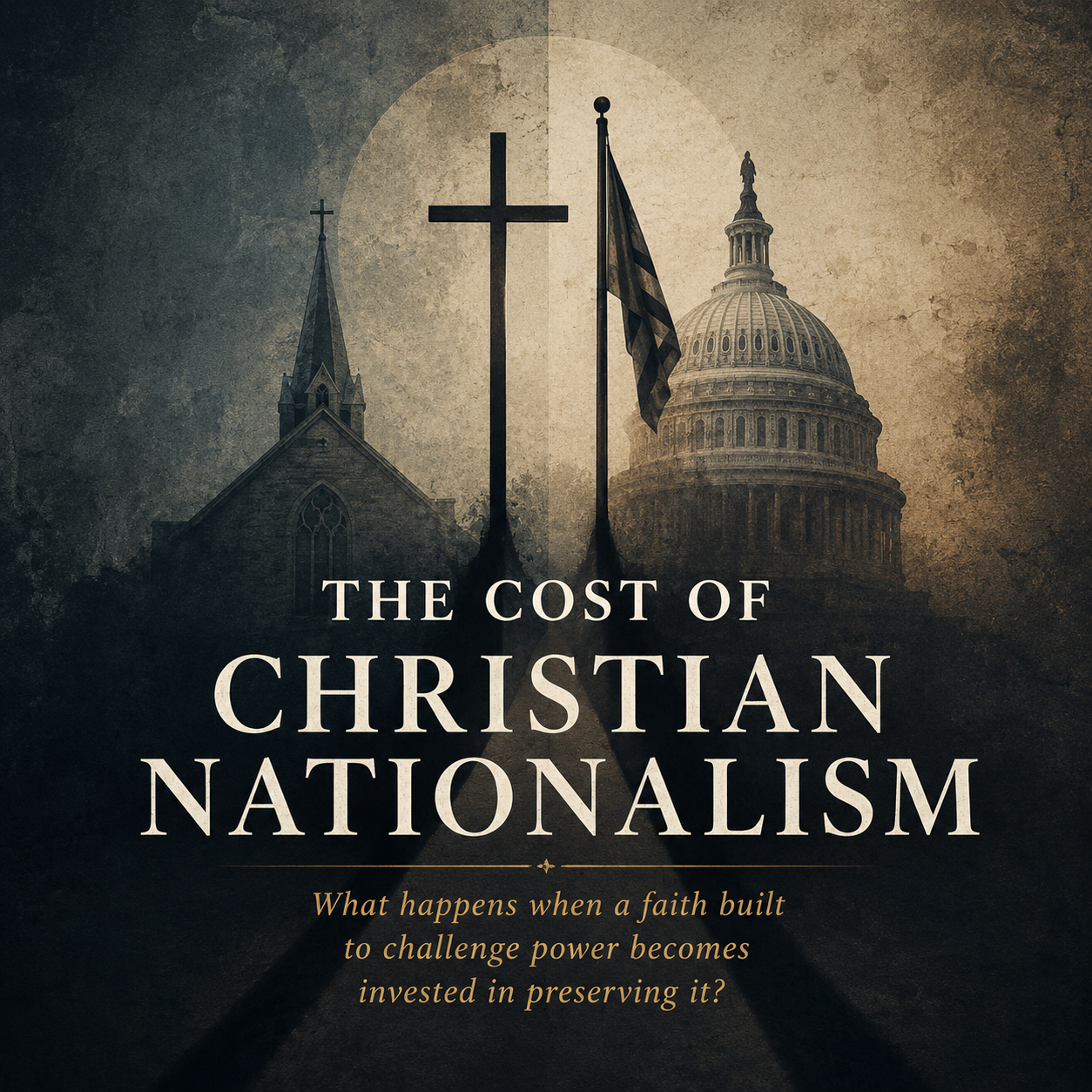
The Cost of Christian Nationalism
What happens when a faith built to challenge power becomes invested in preserving it?
"The central irony of Christian Nationalism is that it often seeks to protect Christianity through methods that stand in tension with Christianity's origins."
By Billy J Bailey
Few terms have moved through American public life as quickly, or as chaotically, as "Christian Nationalism" — a phrase that began largely as an academic framework for understanding the relationship between religious identity and political behavior, and has since become one of the most contested and combustible labels in contemporary discourse. Politicians invoke it as a warning. Critics have written entire books about it. Supporters reject it, embrace it, or redefine it depending on the audience and the moment, sometimes within the same paragraph. Prominent figures like Representative Marjorie Taylor Greene have declared themselves "Christian Nationalists" with apparent pride, while others who share many of the movement's commitments insist the label is a smear invented by the secular left to marginalize ordinary believers. The result is a conversation that generates enormous heat while producing very little clarity.
The term has become, in other words, exactly what powerful political language almost always becomes: a mirror. Different people hold it up and see different threats, different promises, different versions of themselves and their fears — and the argument over what the mirror is reflecting has largely displaced any serious reckoning with what it actually contains.
That reckoning is overdue, not simply as a matter of political analysis but as a matter of intellectual honesty about what this movement is, where it comes from, and what it is likely to cost — not only in terms of democratic norms or civic pluralism, but in terms of the religious tradition it claims to be defending. Because the sharpest critique of Christian Nationalism is not the one its secular critics are making. The sharpest critique is theological, and it has been available within Christianity's own tradition for the better part of two thousand years.
What We Are Actually Talking About
Precision matters here more than usual, because the label is routinely deployed in ways that collapse meaningful distinctions and, in doing so, make serious conversation nearly impossible.
At its most precise, Christian Nationalism describes the belief that Christianity is not merely one influence among many in American life but is instead constitutive of the nation's identity and purpose — that America is, in some essential and non-negotiable sense, a Christian nation, and that its laws, institutions, and public culture should reflect that reality in explicit and enforceable ways. This is not simply the historical claim that Christianity shaped the country's founding, informed its moral vocabulary, or left traceable marks on its legal traditions. Few serious historians would contest any of that, any more than they would contest the formative influence of Enlightenment rationalism, English common law, or the Atlantic slave trade on what America became. Christianity's presence in American development is a fact of history, and acknowledging it requires no particular theological commitment.
What Christian Nationalism adds to that historical observation is a prescriptive and exclusionary claim: that because Christianity was foundational, it must remain central; that the nation's departure from explicit Christian identity represents not merely cultural change but spiritual betrayal; and that the appropriate response to that betrayal is the recovery of Christian governance — the use of political power to restore Christianity to what its adherents regard as its rightful position of cultural primacy.
That claim is qualitatively different from anything that serious historical accounts of religious influence in America actually support, and understanding that difference is essential to understanding what the movement is actually proposing. Christian Nationalism is not, at its core, about protecting the rights of religious people to practice their faith freely. It is not about ensuring that Christians can speak in the public square, run for office, or bring their convictions to bear on questions of law and policy. All of that is protected by the Constitution and has been practiced throughout American history by people of every theological persuasion and none. What Christian Nationalism proposes is something more specific and more ambitious: that Christianity should have a privileged relationship to American political identity that other religious traditions — and, crucially, no religious tradition — cannot share.
The movement also encompasses a range of positions and figures whose differences are real but whose common commitments are more illuminating than the distinctions between them. At one end of the spectrum are figures like Stephen Wolfe, whose 2022 book "The Case for Christian Nationalism" argues with considerable philosophical seriousness for the establishment of explicitly Christian civil government, grounded in a recovery of classical Reformed political theology. Wolfe is careful and systematic; he is arguing for a coherent if radical vision of Christian political order. At another point on the spectrum is Doug Wilson, the Moscow, Idaho pastor whose influence on a generation of conservative Reformed Christians is difficult to overstate, and whose vision of "Christ and culture" tends toward a muscular, occasionally combative cultural dominance that he describes as simple faithfulness and his critics describe as something considerably darker. Then there are figures like Lance Wallnau and the broader charismatic "Seven Mountains Mandate" movement, which holds that Christians are called to occupy and govern the seven spheres of cultural influence — government, education, media, arts, business, family, and religion — as a matter of divine mandate, a framework that has filtered from charismatic conference circuits into mainstream evangelical political consciousness with remarkable speed.
Beneath the theological and temperamental differences that separate these figures lies a shared conviction: that Christianity's relationship to American public life is not merely one of participation or influence but of ownership, and that recovering that ownership is both a spiritual obligation and a political project.
The Long History of an Old Instinct
The language is new. The label is new. The instinct is not, and understanding its depth in American history is essential to understanding why it is so durable and, at the same time, so consistently problematic.
American history contains a long, recurring, and often celebrated tradition of interpreting national events through a specifically theological lens — of understanding the nation's story not simply as the record of human choices and their consequences but as something more charged, more consecrated, more saturated with divine intention. The Puritan settlers of New England did not regard themselves as establishing a colony in the ordinary sense. They understood themselves to be fulfilling a providential commission, and when John Winthrop delivered what would become the most quoted sermon in American history aboard the Arabella in 1630 — warning his fellow passengers that they would be "as a city upon a hill," watched by the world and held to an extraordinary standard — he was articulating not merely a vision of community but a theology of national vocation. That theology did not die with Puritanism. It migrated, transformed, and persisted, available to be retrieved and redeployed by nearly every generation that followed.
The American Revolution was interpreted by many of its participants not simply as a political achievement but as a providential one, evidence that God had repositioned the world's moral center in a new republic that would serve as freedom's exemplar for all of humanity. The Civil War produced some of the most searching theological arguments in American history, with both sides invoking divine authority — Lincoln's Second Inaugural being the rare and remarkable exception, a speech that acknowledged with heartbreaking honesty that God's purposes might not map cleanly onto either side's convictions. Manifest Destiny translated westward expansion into something approaching divine commission, framing the dispossession of Native peoples not as conquest but as the fulfillment of a sacred errand, a reframing that served the political needs of expansion while offering its beneficiaries the comfort of theological sanction.
The twentieth century contributed its own episodes to this tradition. Cold War rhetoric frequently and deliberately cast the United States as the defender of Christian civilization against the atheistic materialism of Soviet communism — a framing that was simultaneously strategic and sincere, serving both the geopolitical needs of containment and the genuine religious anxieties of a culture wrestling with secularization. The addition of "under God" to the Pledge of Allegiance in 1954 and the adoption of "In God We Trust" as the national motto two years later were not simple gestures of civic piety. They were deliberate assertions of religious identity in a context where that identity carried ideological weight, and they came with the explicit endorsement of President Eisenhower, who was not particularly devout but understood the political utility of consecrating the republic at a moment when its global rival was organized around the explicit rejection of God.
What all of these moments have in common is not simply the use of religious language in public discourse. Religious language in public discourse is as old as the republic and hardly disqualifying on its own. What they share is something more specific: the tendency to collapse the distinction between what the nation desires and what God requires, to interpret American political interests as expressions of divine will, and to frame departures from the dominant culture's religious sensibility as betrayals not merely of tradition but of cosmic order.
That habit proved durable across the centuries for reasons that are not difficult to understand. Nations, like individuals, want to believe that their stories matter beyond the merely human scale. They want the suffering to have meant something, the sacrifices to have been purposeful, the accidents of geography and power that produced their particular version of civilization to have been, at some level, intended. Religious language provides a framework for that kind of meaning-making that political language, on its own, cannot. The challenge arises — and it arises with painful consistency throughout American history — when the distinction between the nation's interests and God's purposes becomes not merely blurred but politically inconvenient to maintain.
A Faith Born at the Margins
To understand why that collapse of distinction matters so much, it is necessary to recover something that the Christian Nationalism movement tends, with curious consistency, to underemphasize: the actual circumstances in which Christianity began, and what those circumstances suggest about the faith's constitutive posture toward power.
Christianity did not emerge at the center of anything. It emerged at the periphery of a vast imperial system that had very little interest in it, in a remote province of the Roman Empire, among a people already living under occupation, organized around a figure who never held political office, commanded no army, controlled no territory, and died the death reserved for criminals and slaves. The earliest Christian communities were not gathering in positions of cultural authority or civic influence. They were meeting in homes and catacombs, practicing a faith that the Roman state regarded with suspicion precisely because it made claims that competed with imperial ideology — claims about ultimate loyalty, about who deserved worship, about what kind of authority was legitimate and what kind was not.
The growth of the early church came not through coercion or institutional power but through something that the political imagination struggles to account for: the persuasive force of a community that organized itself around radically counterintuitive practices. The early Christians, as the second-century apologist Tertullian described them, were known for caring for people who were not their own — feeding the poor, visiting prisoners, burying the dead regardless of social status, maintaining a solidarity that crossed the boundaries that Roman society took for granted. Their ethic was not built around dominance but around something stranger and, ultimately, more compelling: the conviction that the last would be first, that the way of the cross was not a symbol of defeat but a revelation of a different kind of power, and that a message that had begun at the very margins of the world was somehow intended for the center of it.
This is not simply a historical curiosity. It is the founding grammar of the tradition, and it establishes a baseline against which later developments can be evaluated. Christianity was not born as a governing institution with a mandate to shape the laws of nations. It was born as a movement with a message, and the terms on which it was to be carried — persuasion, service, witness, the willingness to suffer rather than to inflict suffering — were understood by its earliest communities as intrinsic to the message itself, not merely strategic concessions to political weakness.
The Constantine Problem, and What Followed
The turning point most often cited in this history, and rightly so, is the conversion of Constantine and the gradual incorporation of Christianity into the Roman Empire's governing structures in the early fourth century. The Edict of Milan in 313 extended legal toleration to Christians throughout the empire. Within decades, Christianity had moved from tolerated minority to favored religion. By the end of the century, under Theodosius, it had become the official religion of the Roman state, and the practice of other religions had been progressively restricted.
The benefits of this transformation were obvious and, to Christians who had survived generations of intermittent persecution, genuinely significant. Legal protections now existed where they had not before. Churches could acquire property and build in public. The cultural visibility of the faith expanded dramatically. And persecution — the real, violent, sometimes lethal persecution that had defined the experience of Christians in certain periods and certain provinces — largely ceased.
Yet alongside those gains came a new set of pressures and temptations that the church had not faced in the same form during its first three centuries. Theological disagreements that had previously been settled, sometimes acrimoniously, through councils and argument and the slow accumulation of consensus, now acquired political implications that exceeded anything internal to the community. Christian unity was no longer simply a matter of ecclesiastical integrity; it was a matter of imperial stability, and emperors took an active and sometimes coercive interest in resolving doctrinal disputes that they had no particular theological competence to adjudicate. The Council of Nicaea in 325, which produced the foundational statement of Trinitarian theology that most Christians still affirm, was convened and presided over by an emperor who had not yet been baptized, for reasons that were as much about political coherence as theological truth.
The church gained influence. It also inherited, gradually and not always consciously, the logic of the institutions with which it had aligned. The prophetic voice — the voice that had once spoken uncomfortable truths to imperial power, that had insisted on a loyalty that transcended Caesar's claims, that had organized itself around the needs of the excluded and the forgotten — did not disappear entirely. But it became harder to sustain from within an institution that was itself a beneficiary of imperial favor, and the history of the centuries that followed is, in significant measure, the history of the tension between those two impulses within a tradition that had acquired both.
The Crusades organized military violence under the banner of Christian mission and produced, alongside their enormous human cost, a model of Christianity as a conquering force rather than a serving one that would prove remarkably difficult to dislodge from the Western imagination. The Inquisition operated with the blessing of civil authority, and what began as an instrument of theological discipline became, in practice, a tool of social control whose victims were not simply heretics but dissidents, minorities, and the politically inconvenient. The conquest of the Americas proceeded under a papal decree — the Doctrine of Discovery, issued by Pope Alexander VI in 1493 — that granted Christian monarchs the right to claim lands occupied by non-Christians, a theological sanction for colonial dispossession whose legal echoes persisted in American jurisprudence into the twenty-first century.
None of these episodes represents the entirety of Christianity's record during the periods in which they occurred, and to name them is not to suggest that the tradition produced nothing of enduring moral value during its long centuries of cultural prominence. It produced a great deal. But it did so in spite of, not because of, its entanglement with political power, and the voices within the tradition that proved most valuable — the Francis of Assisi who embraced poverty rather than patronage, the William Wilberforce who challenged the economic consensus of his age, the Dietrich Bonhoeffer who died in a Nazi prison for refusing to allow the church's prophetic voice to be swallowed by the nationalist project it had been seduced into serving — were almost always voices speaking from the margins of the institutional church's relationship to power, not from the center of it.
The Present Movement and Its Architects
The contemporary movement traveling under the banner of Christian Nationalism is animated by concerns that deserve to be taken with genuine seriousness, even by those who find the movement's proposed solutions not merely inadequate but dangerous.
American Christianity has experienced significant institutional decline over the past several decades, a decline that is documented in enough longitudinal survey data to be beyond serious dispute. Church attendance has dropped steadily across virtually every denominational tradition. The percentage of Americans identifying as Christian has fallen from roughly 90 percent in the early 1970s to somewhere around 60 percent today, with the sharpest and most consequential decline among people under 40. Institutions that once functioned as stable anchors of community life — the mainline Protestant church on the town square, the Catholic parish that organized the neighborhood's social calendar, the evangelical megachurch that served as a kind of civic institution for its surrounding suburb — appear increasingly fragile, their attendance declining, their cultural authority diminished, their capacity to shape the moral assumptions of the broader culture visibly reduced.
For many Christians watching these changes, the experience is not abstract or statistical. It is personal and often painful. It involves watching congregations that once held hundreds dwindle to dozens. It involves children who left the faith in college and never returned, not in anger but in indifference, which is in some ways harder to respond to. It involves a sense that a shared moral vocabulary — a set of common assumptions about the nature of human beings, the meaning of family, the basis of obligation to one another — has eroded in ways that make civic conversation feel not merely difficult but impossible, as though the participants are operating from entirely different accounts of what life is for.
The grief behind that experience is real, and the anxiety it produces is understandable. What it produces, in the architects of Christian Nationalism, is a political program — and an increasingly specific and ambitious one.
Doug Wilson, who operates out of Moscow, Idaho and presides over a network of Reformed churches and institutions known as the Communion of Reformed Evangelical Churches, has articulated perhaps the most intellectually coherent version of the project. Wilson's vision, which he has developed across decades of prolific writing and which has reached a generation of young conservative Christians through platforms like Canon Press and his blog "Blog and Mablog," is organized around the conviction that Christianity must move from influence to dominance — that a faithful Christian engagement with culture is not satisfied by Christian citizens voting their values but requires the explicit Christianization of civil society. He calls this "theonomy-lite" by some of his critics and "mere Christendom" by himself, but whatever the label, the substance is a vision of American public life in which Christian norms are not simply one voice in a pluralist conversation but the governing framework within which all other voices operate.
Stephen Wolfe has provided the movement with a more formally philosophical grounding. His 2022 book "The Case for Christian Nationalism," published by Canon Press and received with enthusiasm in certain Reformed and post-liberal Catholic circles, draws on the political theology of the sixteenth and seventeenth century Reformers to argue that nations have a natural character shaped by their particular histories and peoples, that this natural character in America is Christian, and that the goal of Christian political engagement should be the recovery and institutionalization of that character through civil government. Wolfe is careful to distinguish his position from simple theocracy, but the distinction is thinner than he allows; a politics organized around the project of making America explicitly Christian in its governing assumptions is, by any reasonable definition, a politics of religious establishment, regardless of the theological tradition in which it is grounded.
At a less philosophically rigorous but considerably more politically energized point on the spectrum, figures like Lance Wallnau and the broader network of charismatic Christians associated with the "Seven Mountains Mandate" have translated the core conviction of Christian Nationalism into the idiom of spiritual warfare and cultural conquest. The Seven Mountains framework, developed in part by C. Peter Wagner and the New Apostolic Reformation movement, holds that Christians are called by God to "occupy" the seven mountains of cultural influence — government, education, media, arts, entertainment, business, and family — and that this occupation is not merely a political strategy but a spiritual mandate, the fulfillment of which will precipitate the return of Christ or, in some versions, the establishment of his kingdom on earth. Andrew Torba, the founder of the social media platform Gab, has brought a similar framework to bear in explicitly political terms, describing his project as the building of a "parallel Christian economy and society" as a precursor to Christian political recapture of the broader culture.
What unites these figures across their considerable differences of temperament, theological tradition, and political strategy is a conviction that the church's declining cultural influence is a crisis requiring a response that is, at its core, about power — about who holds it, who exercises it, and toward what ends. And it is precisely that conviction, widely shared and deeply felt, that the tradition itself offers the most searching grounds for questioning.
The Theological Reckoning
The most consequential critique of Christian Nationalism is not the one that emanates from secular liberalism, though that critique is real and carries its own force. The most consequential critique is the one that arises from within the tradition itself — from the long, complicated, and surprisingly consistent testimony of Christian theology about what happens to the faith when it becomes primarily organized around the project of cultural preservation and political recovery.
Consider, first, what happens to the church's prophetic function. Christianity inherited from its Jewish roots a prophetic tradition that is, at its heart, a sustained argument against the assumption that national political success reflects divine approval. The great prophets of the Hebrew Bible — Amos and Isaiah and Jeremiah and Micah — were not critics of Israel's faith from outside the tradition. They were passionate insiders, people whose criticism of Israel's political arrangements arose precisely from their deepest convictions about what God had called Israel to be. And what those convictions consistently produced was the insistence that the nation's military strength, its political alliances, its territorial security, and its economic prosperity were not measures of its faithfulness — that God was not, as the surrounding cultures tended to assume, simply the guarantor of national flourishing, a cosmic patron whose favor tracked political success.
Jesus stands in that prophetic tradition, and the political implications of his ministry are more radical than the Christian Nationalism movement tends to acknowledge. He did not organize a political party. He did not cultivate relationships with the Herodian court or seek influence with Roman administration. He spent his ministry among the people whom the respectable religious and political establishment had already written off, and when he was pressed to adjudicate the central political question of his context — the question of tribute to Caesar — his famous answer was designed not to endorse either the collaborationist or the revolutionary position but to refuse the terms of the question entirely, to insist that the categories of Caesar and God were not competitors for the same territory but belonged to entirely different orders of claim.
The early church's relationship to political authority, as it is represented in the New Testament, is not triumphalist. Paul, writing to the church in Rome from a position of considerable personal legal jeopardy, counsels submission to governing authorities while simultaneously insisting that his own highest loyalty runs to a kingdom that no governing authority can represent or contain. The book of Revelation, which the Christian Nationalist movement has sometimes claimed as a resource for its project, is in its historical context a sustained critique of empire — a document produced by a community under persecution and organized around the conviction that the Roman Empire's claim to ultimate authority was idolatrous, not merely wrong, and that the proper response was not accommodation but endurance.
When Christianity becomes primarily organized around the project of maintaining or recovering cultural dominance, something fundamental shifts in its moral center of gravity — and the shift is not, on the evidence of the tradition, toward greater faithfulness. The faith remains recognizable by its symbols and its vocabulary. But the priorities begin to reorganize themselves around the logic of the political project rather than the logic of the Gospel. Political opponents acquire spiritual significance as adversaries not merely of policy but of divine purpose, which makes the ordinary negotiations and compromises of democratic life feel like theological betrayal. The community's boundaries contract to match the boundaries of the political coalition, which means that the people whom the tradition has historically called the church to serve — the poor, the marginalized, the stranger, the ones who cannot contribute to the political project — become, at best, secondary concerns.
There is a concept in Christian theology, developed most carefully in the Reformed tradition from which figures like Wolfe and Wilson draw, called the "spirituality of the church" — the idea that the church has a specific, bounded calling that is not coextensive with every project of cultural or political reform. In its worst historical expressions, this concept has been used to insulate the church from responsibility for the social consequences of its silence. But in its better expressions, it gestures toward something genuinely important: the recognition that the church's particular contribution to human flourishing is not the contribution of a political party or a cultural lobby but something that requires a certain distance from the logic of power in order to remain itself.
The tradition has another way of naming this: the distinction between the church's priestly function and its prophetic function. The priestly function involves maintaining the community, sustaining the rituals and practices through which the tradition is transmitted, holding together the people of God across time. The prophetic function involves speaking uncomfortable truths to power — naming injustice, calling institutions and individuals to accountability, insisting on the claims of the excluded even when the cost of doing so is high. Both functions are necessary. But when a faith becomes closely identified with the political order it once existed to critique, the prophetic function does not simply weaken; it becomes structurally impossible to sustain. It is very difficult to speak truth to power when you have become power. The incentives run entirely in the opposite direction.
What the Historical Record Actually Shows
The argument from historical precedent, on this question, is not ambiguous.
Christianity has demonstrated, across twenty centuries and on every inhabited continent, a remarkable capacity to survive opposition. It survived the Roman persecutions, whose ferocity is well-documented even if their extent has sometimes been exaggerated. It survived the collapse of the Western Roman Empire and the centuries of political fragmentation and violence that followed. It survived the Black Death, which killed a third of Europe and produced a crisis of theodicy from which the medieval church never fully recovered. It survived the wars of religion that followed the Reformation, which were as much a product of Christianity's entanglement with political power as they were a conflict over theological conviction. It survived the Enlightenment's philosophical challenges, the democratic revolutions of the eighteenth century, the industrial revolution's disruption of traditional community, the totalitarian assaults of the twentieth century, and the cultural revolutions of the 1960s and beyond.
What it has consistently struggled with — what has produced its most profound and recurring crises of integrity — is not opposition but success. More precisely, it has struggled with the temptation that power brings: the temptation to confuse cultural influence with theological faithfulness, to treat institutional strength as evidence of spiritual health, to measure the church's vitality by its proximity to the centers of social and political authority.
The medieval Catholic Church, at the height of its institutional power, was by virtually every external measure the dominant force in European civilization. It controlled enormous financial resources, commanded the loyalty of monarchs, shaped the intellectual life of the universities, and possessed an administrative apparatus that spanned the continent. It was also, by the assessment of the reformers who arose within it — not from outside, but from within its own conventicles and monasteries and academic faculties — in profound spiritual crisis, a crisis produced in no small part by its entanglement with exactly the kind of political and economic power that its founder had conspicuously refused. Luther's confrontation with that crisis was not primarily a political argument, even though it had consequences that reshaped European politics for centuries. It was a theological argument about what the church had become in the course of becoming powerful.
Dietrich Bonhoeffer, writing from a Nazi prison in which he was eventually executed, diagnosed with extraordinary precision the mechanism by which that kind of corruption operates. The German church of the 1930s had not, for the most part, simply chosen evil. It had made a series of accommodations, each individually defensible, each seeming to preserve the institution's ability to continue its work, each drawing the institution a little further into complicity with a political project that was organizing itself around the explicit inversion of everything the Gospel taught. The church that blessed the National Socialist project with its liturgical presence did not set out to become a chaplain to evil. It set out to survive, to maintain its influence, to protect its institutional prerogatives — and in doing so, it became precisely what Bonhoeffer called "cheap grace," a Christianity that had purchased its comfort by abandoning its content.
The mechanism Bonhoeffer identified does not require anything as dramatic as Nazism to operate. It operates wherever a faith tradition becomes sufficiently invested in political outcomes that the outcomes begin to determine the faith's priorities rather than the other way around.
The Question Worth Sitting With
None of this argues for the church's withdrawal from public life, and it would be a serious misreading of the tradition to draw that conclusion. Christians have always engaged in public life, brought their convictions to bear on contested civic questions, and understood their participation in political community as an expression of their deepest commitments rather than a distraction from them. The question is not whether Christians should be politically engaged. The question is what the terms and spirit of that engagement should be.
The tradition's most durable voices — the ones whose moral authority has aged best across the longest stretches of time, whose witness looks more rather than less impressive with the passage of the decades that would strip away contingent political victories and expose what was actually there underneath — have tended to share a particular posture. They engaged the world from a position of service rather than dominance. They sought the flourishing of people who could offer them nothing politically. They spoke uncomfortable truths to power even when the cost of doing so was high, which is the only condition under which speaking truth to power means anything at all. And they maintained, sometimes at considerable personal cost, the distinction between what they believed God required and what their political moment demanded.
That posture is not weakness. It is, on the evidence of the tradition, the condition under which the faith's distinctive contribution to human flourishing becomes possible. A Christianity organized around the project of recapturing cultural dominance has, by that organization, already foreclosed some of what it most needs to contribute — the willingness to challenge the powerful, to identify with the marginalized, to insist on the moral claims of people who cannot advance anyone's political project.
The version of Christianity most capable of shaping American culture for the better is, in all likelihood, not the version most aggressively seeking to control it. This is not a paradox invented by the movement's critics. It is a conclusion that the tradition has been working toward for two thousand years, through failures and recoveries and the long, complicated process by which a faith that began in powerlessness has learned — imperfectly, repeatedly, at great cost — what powerlessness was trying to teach it.
Christian Nationalism's most significant cost may not be what it does to American democracy. The republic has survived worse than this, and it will litigate the boundaries of religious authority in public life through exactly the slow, contested, democratically accountable processes that define it.
The more significant cost is what it does to American Christianity — to the tradition's capacity to speak, with moral authority and genuine credibility, to a culture that is watching carefully to see whether the faith's claims about love and justice and the dignity of every human being are convictions or simply pretexts for the ordinary pursuit of power.
That question is not one that any political victory can answer. It is answered only in the long arc of the tradition's actual practice, in whether what is passed on to the next generation is a living faith capable of honest self-examination, or a political identity dressed in liturgical clothing and calling itself by the name of something it has quietly ceased to be.
The stakes of that question are higher than any election, and they deserve to be treated accordingly.