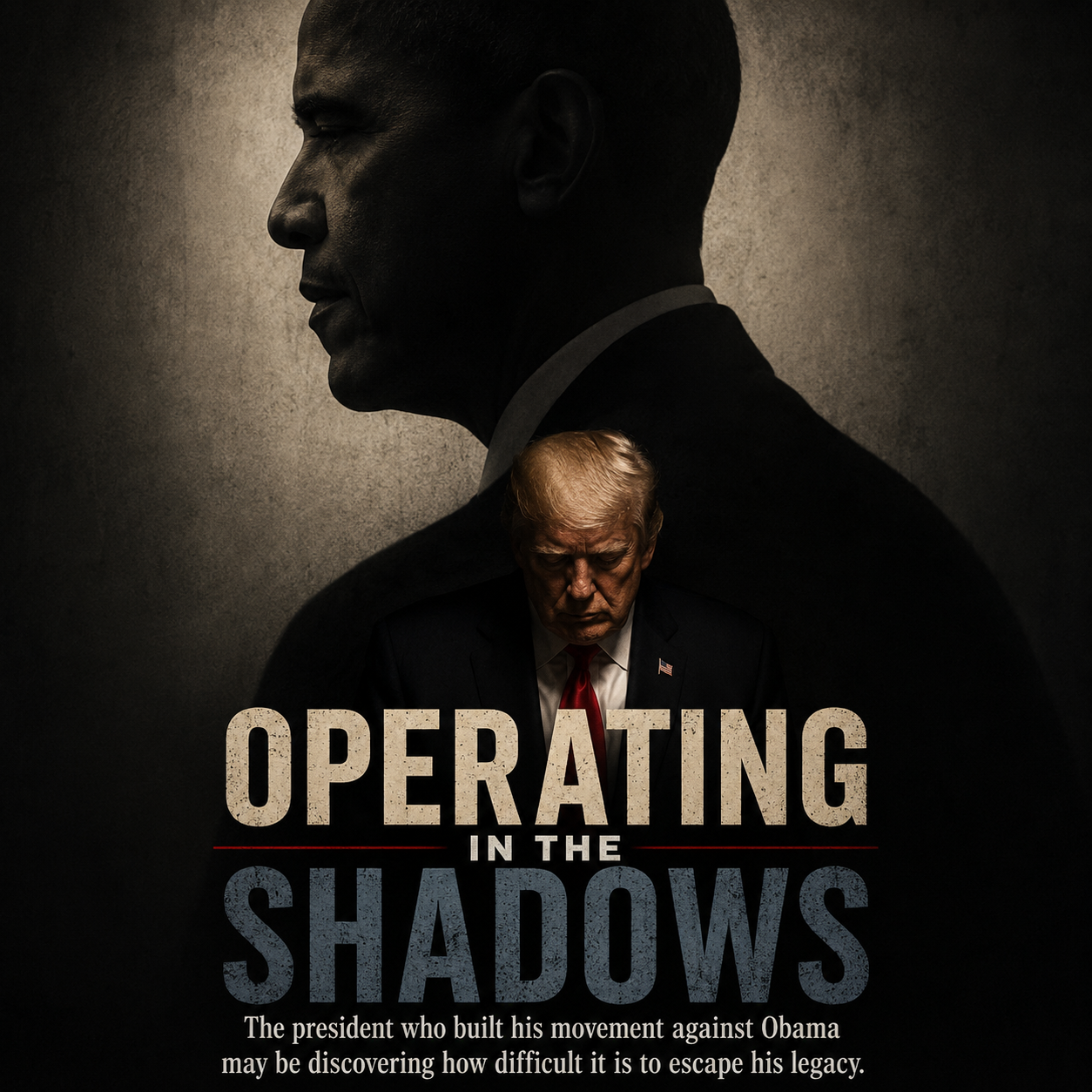
Operating in the Shadows
The president who built his movement against Obama may be discovering how difficult it is to escape his legacy.
“The question facing Republicans is no longer whether they oppose the Obama-Clinton worldview that defined so much of the last decade. The question is whether, after all these years, they are beginning to rediscover parts of it.”
By Billy J Bailey
For a decade, no foreign policy argument did more to define the Republican Party than its rejection of Barack Obama's nuclear agreement with Iran. The 2015 deal was not simply unpopular among conservatives. It became a kind of organizing principle, the clearest available proof that the Obama-Clinton worldview had mistaken weakness for sophistication, restraint for strategy, and patience for a plan. Donald Trump built a significant part of his political identity on that critique, and in May 2018 he made good on it, withdrawing the United States from the Joint Comprehensive Plan of Action and declaring that no version of engagement with Tehran could be trusted to hold.
Eight years later, Trump has signed his own agreement with Iran. And the figures most unsettled by it are not Democrats. They are the same Republicans, including the man who once stood beside him in the Situation Room, who spent a decade insisting Obama's mistake was never personal. It was structural. It was the belief that economic incentives could be traded for nuclear restraint before that restraint was verified, durable, and complete. Trump is now asking his own party, and his own former vice president, to extend exactly the kind of trust it once argued should never be extended at all. Less than a week into the agreement, that trust is already being tested in ways even its harshest critics did not anticipate.
A Deal Signed on a Birthday
The agreement Trump's team finalized this month follows a brief but intense war. Israeli strikes on Iranian nuclear facilities in early June were followed by direct American involvement, and within weeks a ceasefire gave way to a fourteen-point memorandum of understanding covering Iran's enrichment program, the reopening of the Strait of Hormuz, and a path toward sanctions relief. Trump announced the breakthrough on Truth Social on what happened to be his eightieth birthday, and the deal was formally signed the following Friday. Tucked inside the agreement is a provision establishing a reconstruction fund for Iran, reportedly worth as much as $300 billion, financed by private investors rather than American taxpayers. In exchange, the administration has framed the deal as the opening move in a sixty-day window of further negotiation, not a final settlement.
The Senate Reads the Fine Print
Senate Republicans began reading the fine print last week, and what they found did not sit well.
Tom Cotton, who chairs the Senate Intelligence Committee and has been arguing against engagement with Tehran since he wrote an open letter to Iran's leadership as a freshman senator in 2015, told Fox News he had concerns that "certain aspects of this deal are stepping in the wrong direction." Cotton has quietly cultivated a 2028 presidential campaign for years, making stops in Iowa and courting donors even after passing on a run in 2024, and he remains a fixture on every credible list of potential Republican contenders for the next open primary.
Ted Cruz was less restrained, telling reporters that history shows giving billions of dollars to people he described as theocratic extremists "is not a good idea," and adding that the president was receiving poor advice.
Bill Cassidy, who lost his primary this spring to a Trump-endorsed challenger after voting to impeach the president in 2021, went further still, calling the agreement "the worst foreign policy blunder in decades" and comparing it, pointedly, to the deal Republicans spent a decade attacking. "It's kind of JCPOA-plus," he told The Hill, a comparison made easier to deliver, perhaps, by a senator with nothing left to lose within his own party.
Roger Wicker, who chairs the Senate Armed Services Committee, issued his own statement raising concerns about the same reconstruction fund while Lisa Murkowski asked the most uncomfortable question of all without raising her voice. If the fund represents something on Iran's ledger, she said on the Senate floor, "what is the corresponding win for the United States?" It is, more or less, the question Republicans asked Obama in 2015. It has simply changed authors.
The Vice President Who Helped Build the Case Against This
But it is Mike Pence whose criticism carries the most weight, and the most discomfort, precisely because of who he used to be.
Pence served as Trump's vice president for four years, stood beside him as the administration withdrew from the JCPOA, and spent much of his time in office building the case that the original Iran deal represented a generational failure of American resolve. In 2018, addressing the Israeli Knesset, he was the first senior American official to visit Jerusalem after Trump recognized it as Israel's capital, and in the years before that he toured European capitals urging allies to abandon the Obama-era agreement and rejoin what he called a unified front of economic and diplomatic pressure against Tehran. There was no ambiguity in Pence's record on Iran. He was not a skeptic of the maximum-pressure campaign. He helped build it.
Pence has said repeatedly, including in a Meet the Press interview last year, that he does not see another presidential run in his future. But the speculation has never fully gone away, fueled in part by his willingness, unlike nearly every other Republican who served under Trump, to criticize him directly and often. A man positioning himself as the conscience of his party, whether or not he intends to seek its nomination again, has every reason to make that critique as sharply as Pence just did.
Which is what makes his reaction to Trump's new agreement so striking. "The reported MOU with Iran smacks of the kind of appeasement that we saw during the Obama years, the kind of appeasement that Joe Biden tried to accomplish and was ignored by the Iranians, and we rejected categorically during the first Trump administration," Pence wrote on social media the day the deal's terms became public. Speaking to CNN's Kaitlan Collins the following night, he went further, calling the agreement "much bigger than a mistake" and warning that the reconstruction fund, brokered while Iran's Revolutionary Guard remains firmly in control of the country, was "deeply ill-advised." Asked directly by Collins whether he considered it a mistake, Pence didn't hedge. "Well," he said, "it's much bigger than a mistake." His preferred alternative was the same posture his own administration had once championed. Keep the pressure on. Keep the blockade in place. And if Tehran would not meet fundamental terms, in his words, let the armed forces of the United States finish the job on its own.
It is one thing for Tom Cotton or Ted Cruz, men who have spent their careers as Senate hawks, to find Trump's agreement insufficiently tough. It is a different thing entirely for the man who spent four years as Trump's own vice president, defending Trump's own withdrawal from a nearly identical framework, to look at Trump's new deal and conclude it resembles the very appeasement he once stood on a stage in Jerusalem to condemn. Pence is not critiquing Obama's ghost. He is critiquing the man he served, using language calibrated almost exactly to the language that man once used against Obama.
A Time for Choosing, Revisited
That criticism did not arrive in isolation. Just weeks earlier, in a Wall Street Journal opinion piece adapted from his forthcoming book, Pence had already laid out the broader argument the Iran deal now seems to confirm. "Will we remain a party of conservative principles or will we follow the siren song of populism?" he asked, framing the choice facing Republicans as a fundamental one between a coherent philosophical tradition and what he described as a grievance-driven movement assembled, in his telling, from opinion polls and personal resentment rather than fixed conviction. Pence argued that Trump's instincts, however conservative they may once have appeared, had increasingly diverged from conservatism itself, citing the president's growing comfort with industrial policy, tariffs, and what Pence called demands that the administrative state "settle contract disputes between businesses and unions." Populism, he wrote, "complains that our allies and trading partners are taking advantage of us," but offers no fixed principle in return, only the shifting verdict of momentary popular sentiment. "Principles are final," Pence wrote. "Popular opinion is fickle."
Read against that backdrop, Pence's reaction to the Iran agreement looks less like an isolated foreign policy dispute and more like a test case for the very argument he had just published. If populism, in his formulation, is a philosophy without a fixed compass, content to follow Trump's instincts wherever they happen to lead rather than hold him to a consistent standard, then a deal that grants Iran $300 billion in reconstruction financing in exchange for promises rather than dismantlement is precisely the kind of outcome his op-ed warned against. Pence is not simply disagreeing with a policy choice. He is, whether he intends it this way or not, demonstrating his own thesis in real time, showing that even the man who spent four years inside Trump's foreign policy apparatus has concluded the apparatus no longer answers to principle so much as to the president's instinct of the moment.
Mechanism, Not Man
That distinction, between mechanism and man, is the heart of the matter, and it is worth sitting with rather than rushing past it. For ten years, Republican orthodoxy held that mechanism was the problem with Obama's deal, not the man behind it, however much the politics of the moment blurred the two. Sanctions relief offered too early. Verification regimes that depended on Iranian cooperation rather than independent enforcement. A bet that economic normalization would, over time, produce behavioral change Tehran had given the world no real reason to expect. Marco Rubio said he would tear up the agreement on his first day in office if elected. Scott Walker promised the same. Cruz stood beside Trump at a Capitol Hill rally in September 2015 and told the crowd that anyone who voted for the deal would have blood on their hands, naming Speaker John Boehner and Majority Leader Mitch McConnell as Republicans who could still stand in the way of repeal. The objection was never just that Obama negotiated. It was that he negotiated from a position of strength and chose to spend that strength on promises rather than permanent, verifiable change.
What Obama Actually Had
It is worth remembering exactly how much leverage Obama had built before he ever sat down with Iranian negotiators, because the contrast with the current moment is not incidental. The sanctions regime that preceded the 2015 deal took years to assemble. It required sustained coordination among the United States, the European Union, Russia, and China, an alignment that was itself a diplomatic achievement and one rarely credited as such by the deal's critics. Iranian oil exports were cut by more than half. Iran's access to the SWIFT financial messaging system, the plumbing that connects global banks, was severed. Foreign investment that had trickled into the country in better years dried up almost entirely. Even Obama's sharpest critics in 2015, Pence included, rarely disputed that the pressure campaign itself had worked exactly as designed. Their argument was narrower and, in retrospect, more durable than the broader case against engagement: that trading away hard-won leverage in exchange for promises, rather than for irreversible structural change, was a bet the United States was likely to lose slowly and lose anyway.
Trump's agreement emerges from different terrain, and the administration's defenders are right that the comparison is not exact. The war in June 2026 inflicted real damage on Iran's nuclear infrastructure and its economy, and oil prices that spiked from $67 to $120 a barrel before the ceasefire are one measure of how disruptive the conflict became for ordinary Iranians as well as global markets. Military pressure is not the same instrument as economic sanctions, and there is a reasonable argument that a regime negotiating in the aftermath of strikes on its nuclear facilities is operating under a different kind of duress than one negotiating to avoid them. But the international sanctions architecture that made 2015 possible, the coordinated, multilateral squeeze that even critics conceded was working, no longer exists in anything like the same form. Iran's critics, Pence loudest among them, argue that a $300 billion reconstruction fund, however privately financed and however the administration frames it, hands Tehran exactly the kind of lifeline Republicans spent a decade insisting should never be extended without ironclad guarantees attached. The leverage Obama built over years, Trump appears willing to spend in weeks.
The Case for Trusting This Time
Perhaps the administration is right that this time really is different. Perhaps a deal struck in the immediate aftermath of a war, rather than one negotiated specifically to avoid one, carries a kind of psychological leverage Obama never had access to. That is a defensible position, and Lindsey Graham's evolving view of the memorandum suggests at least some Republicans find it persuasive once they hear the administration's case directly. Graham, who initially called himself skeptical that Iran would abandon its nuclear ambitions, came around after a briefing from Middle East envoy Steve Witkoff and now argues that without the memorandum, there is no pathway to ending Tehran's nuclear program at all, even as he continues to call certain elements of it troubling. Vice President JD Vance has taken the lead in defending the deal publicly, telling reporters that much of what critics believe about the agreement is "fundamentally untrue" and urging Republicans to extend the president some trust, given what Vance has called Trump's decade of consistency on the underlying goal of preventing an Iranian weapon.
But the question facing Republicans now is not really whether Trump personally can be trusted to drive a hard bargain. It is whether the principle they spent a decade defending, and that Pence built much of his political identity defending, was ever actually about the mechanics of leverage and verification, as they always insisted, or whether it was about Obama specifically, a distinction without a difference until the moment his name was no longer attached to the page. Pence, of all people, seems to be answering that question the hard way, by holding Trump to the same standard he once held Obama, regardless of what it costs him within a party that has shown little patience for his recent dissent.
Two Wings, One Party
The split inside the party is not simply between supporters and critics of this particular agreement. It runs along a fault line that predates the deal itself and that the deal has only made visible, and that several of its loudest critics have been actively widening for months in anticipation of a primary that does not yet officially exist. Cruz, who ran for the nomination himself in 2016, has spent recent months laying deliberate groundwork for another attempt, courting donors, working the speaking circuit, and waging a public feud with Vance ally Tucker Carlson over what Cruz has called Carlson's "dangerously isolationist" instincts and his tolerance for rising antisemitism on the right. People close to Cruz say he has told donors directly that he intends to position himself as the hawkish, pro-Israel alternative to Vance, who is widely seen as the front-runner in any post-Trump primary. Asked point blank in November whether he was eyeing a run, Cruz did not deny it. "Reporters are going to write headlines that get clicks and get eyeballs," he said, before pivoting to his record. The Iran deal, and his refusal to call it a betrayal even as he raises hard questions about its terms, fits a senator trying to thread a careful needle: hawkish enough to challenge Vance from the right on foreign policy, loyal enough not to be cast as a Pence-style apostate.
That needle is the clearest illustration yet of a fault line running underneath the entire party. One wing of the coalition, represented by Cotton, Cruz, Wicker, and now unmistakably by Pence, has never abandoned the maximum-pressure framework that defined Republican foreign policy throughout Trump's first term and the years preceding it. For that wing, strength is measured in sustained pressure, and any agreement that relieves it before total capitulation looks less like diplomacy than like surrender dressed in different language.
A second wing, loosely associated with Vance and with the restraint-minded nationalism that has grown inside the party since 2016, distrusts foreign intervention on principle and has, at times, been just as uneasy about military escalation as it now claims to be comfortable with negotiated settlement. Vance himself embodied that tension directly. Two days before the strikes on Iran began, he told The Washington Post he was a "skeptic of foreign military interventions" who preferred a diplomatic option. Within months he was defending both the strikes and the negotiated settlement that followed them as a single, consistent expression of Trump's decade-long position on Iranian enrichment. Both things can be true.
The administration's public rhetoric over the course of the conflict was genuinely inconsistent, shifting from deterrence to nuclear prevention to occasional suggestions of regime pressure before settling back into negotiation, and Trump's underlying commitment to preventing an Iranian weapon may not have wavered at all beneath that shifting rhetoric. Americans tend to tolerate ambiguity in the middle of a crisis. They notice it once the dust has settled, the ceasefire has held, and the bill arrives itemized. What no one quite anticipated was how quickly the dust would refuse to settle at all.
The Deal Cracks Within Days
Iran's military command announced Saturday (June 20th) that it had closed the Strait of Hormuz for the second time in a week, accusing the United States and Israel of violating the memorandum's very first clause, the commitment to halt fighting on every front, including Lebanon. The closure came hours after Israeli strikes killed more than a dozen people in southern Lebanon, just as a separate ceasefire between Israel and Hezbollah appeared to be taking hold. U.S. Central Command disputed Iran's claim within the hour, insisting commercial traffic through the strait had actually increased that day. But the dispute itself was telling. Less than a week after Trump signed the agreement on his birthday, the two sides could not even agree on whether the central artery of the entire arrangement was open or closed.
The diplomatic damage may prove harder to dispute than the shipping logs. Special envoys Steve Witkoff and Jared Kushner were already in Switzerland preparing for follow-on talks in Bürgenstock when the renewed strikes forced those talks into limbo. Vance, who had planned to join them, instead found himself back at the White House podium defending the agreement against an entirely new front of criticism, this time aimed not at Tehran but at Jerusalem.
It was not a posture Vance handled gently. Pressed on Israel's continued strikes in Lebanon, he warned that Israeli officials would be wise to reconsider attacking, in his words, "the only powerful ally that I have anywhere left in the entire world." It was a remarkable sentence for an American vice president to say about Israel, and it did not go unnoticed within his own party. Florida congressman Randy Fine called the comments "absolutely inappropriate and frankly disgusting." Fox News host Brian Kilmeade said he was "shocked," adding that he wished Vance would direct that same toughness at Iran instead. Newt Gingrich asked, more pointedly, why Israel was being blamed for defending itself against Hezbollah at all. For a senator like Cruz, who has staked his own future ambitions on being the most reliably pro-Israel voice in any post-Trump field, the moment landed as something close to validation.
The episode captures, in miniature, the very tension this piece has been tracing from the start. A vice president who spent the deal's first week defending it from Republican hawks spent its second week defending it from Israel's American allies, using language that startled members of his own coalition more than anything Cotton, Cruz, or Pence had said about Iran itself. The deal Trump built to demonstrate that pressure could finally be converted into a lasting outcome now depends on persuading Israel, the closest ally named in the arrangement, to stop applying pressure of its own. Whether that holds is a question for the coming days. That it was already in question less than a week in says something about how durable the underlying agreement actually is, and about how quickly the coalition built around opposing one president's foreign policy can fracture once it is asked to defend another's.
What the Coalition Was Actually Built On
What makes this moment more than a policy dispute, then, is what it threatens to expose about the coalition Trump assembled, and what Pence's own recent writing suggests he already half expected. That coalition was never as unified as it looked from the outside, and it was never built primarily around a shared theory of statecraft. It was built around opposition to a man and, more specifically, to the assumptions that man was believed to represent. Hawks and restrainers, institutionalists and populists, all coexisted comfortably enough as long as the unifying task was rejecting Obama's foreign policy rather than constructing an alternative with its own internal tradeoffs. An actual agreement, with actual terms, an actual price tag, and an actual sixty-day clock now running, does not offer that kind of unifying clarity. It forces a choice between the instinct that produced a decade of criticism and the deference that has, until now, restrained it.
Cotton, Cruz, and Pence are choosing the instinct. Vance and, more cautiously, Graham are choosing the deference, even when that deference now requires defending the deal from Israel rather than from Iran. Trump, for the moment, is asking the rest of the party to decide which version of itself it actually is, and at least three of the men most prominently making that case have their own reasons, beyond conviction alone, for wanting the party to choose the way they are choosing.
This is where Obama's shadow falls longest across the moment, not because Trump has become Obama in any meaningful sense, but because the gravitational pull of the presidency itself seems to operate independent of who occupies it. Obama discovered, after the brutal calculus of Syria, that military credibility and diplomatic patience were harder to hold simultaneously than his rhetoric had once suggested. Trump now appears to be discovering something adjacent: that the leverage built through pressure, whether sanctions or strikes, has to be spent on something, and that the spending itself is where doctrine collides with reality. The war he authorized in June produced genuine battlefield results. What he has done with those results looks, to a meaningful and increasingly vocal portion of his own movement, including the man who once stood a half step behind him at the podium, uncomfortably similar to what they spent a decade condemning Obama for attempting with far less military justification behind it.
Aberration or Admission
Whether the party concludes that Trump's Iran agreement was an aberration, a one-time accommodation forced by unusual battlefield conditions and the particular instincts of one president, or an admission that pressure was never going to be a strategy unto itself will likely shape Republican foreign policy long after Trump has left office. If it is treated as an aberration, the party will likely return to the framework it spent ten years building and defending, one that treats diplomacy as a last resort to be conceded as little as possible and measures strength almost exclusively by the willingness to withhold it.
Cotton, Cruz, Wicker, and Pence would be the natural standard-bearers of that continuity, and given the durability of their objections this week, there is little reason to think they would have much trouble rebuilding consensus around it once Trump is no longer the variable holding the coalition together. Cotton, Cruz, and Pence are all, in their own ways and to varying degrees of candor about it, already positioning themselves for a 2028 primary that will be fought substantially over this same question, and a foreign policy fight this visible is not the kind of moment career politicians wade into by accident.
If it is treated instead as an admission, the implications run considerably deeper, and they would vindicate the very warning Pence issued in print just weeks before the deal's terms became public. It would suggest that even the most disruptive foreign policy movement of the last decade arrived, eventually, at a version of the conclusion most of its predecessors reached through their own separate crises: that pressure creates leverage, but leverage still has to be converted into an outcome, and that conversion happens almost without exception at a negotiating table rather than at a distance from one. It would not amount to a restoration of the pre-2016 Republican foreign policy consensus. That coalition no longer exists, and the objections raised this week by Cotton, Cruz, and especially Pence make clear that a meaningful and influential wing of the party has no interest in resurrecting it wholesale. But it might point toward something more candid than the framework Republicans have operated under since the original JCPOA fight, one willing to acknowledge, finally, that the hardest part of foreign policy was never really deciding whether to negotiate with adversaries. It was deciding, with clear eyes and in full view of one's own coalition, exactly what to give up in order to do it, and living with the answer regardless of whose name happened to be on the page.
That is the shadow Trump built his movement to escape. His own former vice president is still standing in it. And as of this week, so is his own vice president, defending a deal that now requires him to choose, in public and in real time, between Iran's complaints and Israel's, the very kind of tradeoff the maximum-pressure era was supposed to have made unnecessary.