Obama v. Trump: Who Could Win in a Head-to-Head Matchup in 2028?
A constitutional impossibility, a political fantasy, and perhaps the most fascinating election America will never have.
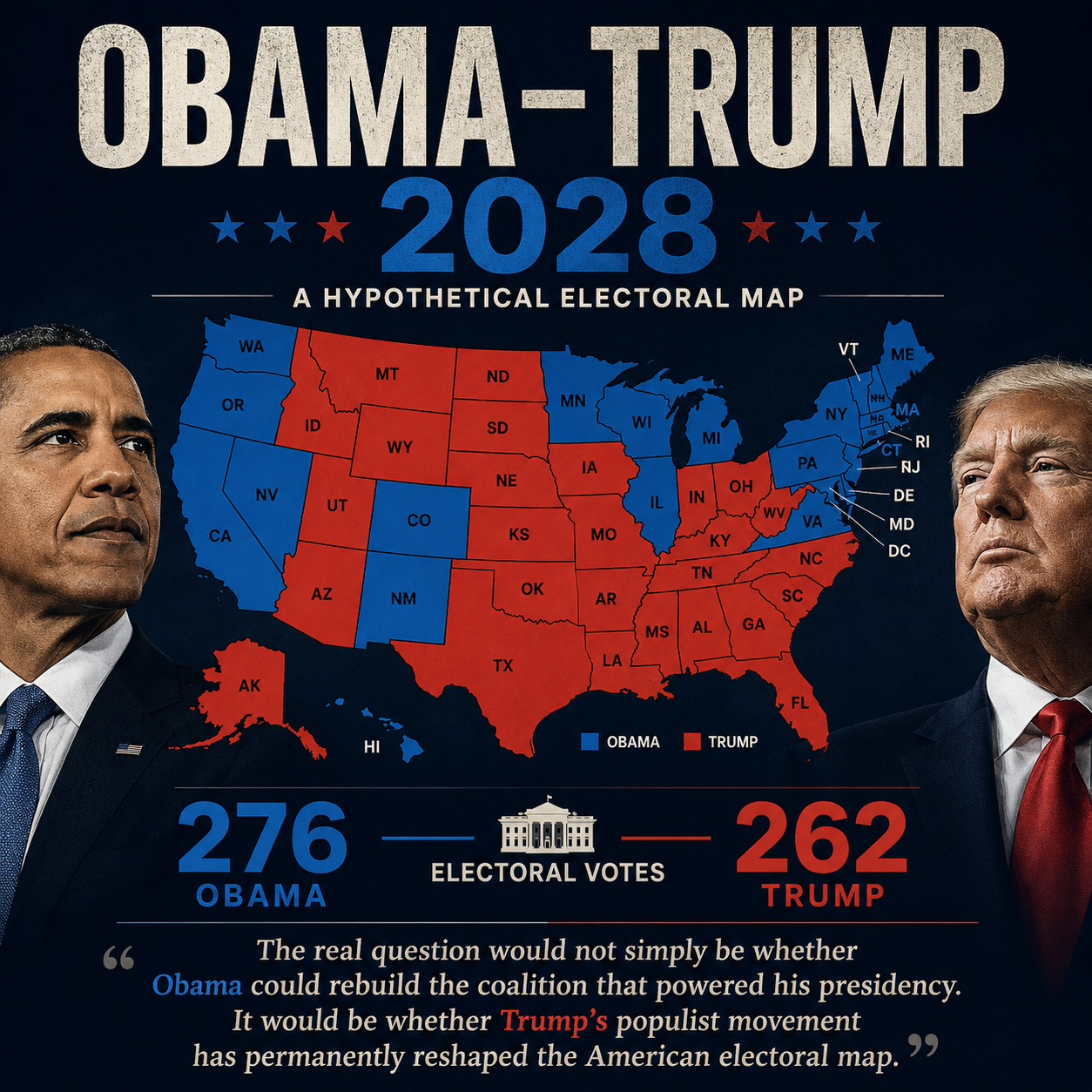
"The real question would not simply be whether Obama could rebuild the coalition that powered his presidency. It would be whether Trump's populist movement has permanently reshaped the American electoral map."
By Billy J Bailey
Every few months, Donald Trump flirts with the idea again: Maybe the Constitution isn’t the final word on presidential term limits. Maybe there is a path to a third term after all. Trump usually raises the notion half-seriously — sometimes as a joke, sometimes as a jab at political opponents — but the suggestion inevitably triggers the same debate. The 22nd Amendment, ratified in 1951 after FDR’s historic and unprecedented four electoral victories, states clearly that no person shall be elected president more than twice. On paper, the conversation ends there.
In reality, the constitutional barrier is formidable but not theoretically impossible to overcome. One path would require repealing or modifying the 22nd Amendment, a process demanding a two-thirds vote in both houses of Congress followed by ratification from three-quarters of the states. The second, more speculative scenario would involve a legal reinterpretation of the amendment itself, arguing that it prevents someone from being elected president more than twice but does not explicitly bar them from serving again under extraordinary circumstances. That argument would almost certainly trigger immediate legal challenges and a Supreme Court showdown. In practical terms, either route would require a level of political consensus that simply does not exist.
If that constitutional barrier somehow disappeared, the political implications would be extraordinary. An Obama–Trump showdown would pit two presidents who defined successive eras of American politics. Both built mass followings. Both reshaped their parties. And both remain among the most recognizable — and polarizing — figures in modern political life.
Barack Obama’s electoral résumé remains one of the most formidable in modern Democratic politics. His 2008 victory over John McCain was more than a win — it was a landslide that reshaped the electoral map. Obama captured 365 electoral votes and nearly 53 percent of the popular vote, carrying traditional battlegrounds like Florida and Ohio while briefly flipping states such as Indiana and North Carolina. Four years later, in 2012, he secured reelection with 332 electoral votes, defeating Mitt Romney while maintaining the Democratic “Blue Wall” across the industrial Midwest. Obama’s coalition combined strong support from minority voters with high turnout among young voters and growing strength in suburban America.
Yet Obama governed during a period of intense polarization. His presidency coincided with the rise of the Tea Party movement and fierce Republican opposition, particularly over the Affordable Care Act and federal spending. His approval ratings typically hovered between the mid-40s and low-50s — a reflection of a country deeply divided along partisan lines. While Democrats overwhelmingly embraced him, Republicans viewed his presidency with far more skepticism. Critics on the right often portrayed him as overly progressive, while some voices on the left argued that he governed too cautiously. In a hypothetical matchup against Donald Trump, Obama would likely rely on the political strengths that powered his two national victories. He demonstrated an unusual ability to build broad electoral coalitions, combining minority voters, young voters, suburban moderates, and independents into a durable majority. In battleground states like Michigan, Pennsylvania, and Wisconsin — states central to Democratic presidential victories for decades — Obama’s coalition once proved particularly resilient. The challenge, however, is that the political terrain of the late 2020s is not the same one Obama navigated in 2008 or 2012.
Donald Trump’s electoral record is unlike almost anything in modern presidential politics. In 2016, he defeated Hillary Clinton while losing the national popular vote, winning the presidency with 304 electoral votes after flipping several Midwestern states that Democrats had long considered part of their electoral firewall. In 2020, he lost to Joe Biden but dramatically expanded his vote total, receiving more than 74 million votes, the second-highest number ever recorded at the time. Four years later, in 2024, Trump returned to the White House with another Electoral College victory, underscoring the durability — and intensity — of his political base.
Trump’s appeal has always been paired with unusually high political polarization. Throughout his career, his favorability ratings have remained sharply divided, with strong loyalty among Republican voters but deep opposition from Democrats and many independents. During his presidency, his approval ratings often hover between the low and high 40s. Critics frequently point to his confrontational rhetoric and institutional clashes as liabilities, while supporters view those same traits as evidence that he is willing to challenge political elites and disrupt the traditional establishment.
In a matchup with Obama, Trump would likely lean on the populist coalition that reshaped Republican politics in the late 2010s. His strongest support comes from working-class voters, rural communities, and voters skeptical of federal institutions. In recent elections, Trump also narrowed Democratic margins among some Hispanic voters and working-class voters across several states. Those shifts helped make previously safe Democratic states competitive again. But Trump would still face the same challenge that has followed him throughout his political career: high unfavorability ratings among suburban voters and moderates who often determine the outcome of close national elections.
A Obama–Trump matchup would almost certainly become one of the most watched elections in modern history. It would not simply be a contest between two candidates but a referendum on two competing political eras. Obama represents the coalition politics that defined the late 2000s — multicultural, urban-suburban, and internationally oriented. Trump represents the populist realignment that reshaped the Republican Party in the late 2010s — nationalist, anti-establishment, and heavily rooted in working-class frustration with political institutions. A race between them would likely produce historic turnout.
Electorally, the battle would likely come down to the familiar battlegrounds that have decided recent presidential contests. The industrial Midwest — Michigan, Pennsylvania, and Wisconsin — would once again sit at the center of the map. Obama’s coalition once dominated those states, but Trump proved capable of flipping them when Democratic turnout faltered. Meanwhile, rapidly changing Sun Belt states like Arizona, Georgia, and Nevada could further complicate the picture. The real question would not simply be whether Obama could rebuild the coalition that powered his presidency. It would be whether Trump’s populist movement has permanently reshaped the American electoral map.
What makes the thought experiment so intriguing is that Obama and Trump represent two entirely different theories of American politics. Obama’s rise was built on the idea that the country’s growing diversity and suburban moderation could form a durable national majority. Trump’s rise challenged that assumption, proving that a populist coalition rooted in working-class frustration and cultural backlash could still win the presidency. An Obama–Trump election would not simply revisit the past. It would determine which political era still defines America.
The cover image reflects a projection based on each candidate’s historical electoral performance and the political geography that has emerged in recent presidential elections. It is not a prediction of what would happen in a future race, nor is it intended as a definitive forecast. Rather, it models how the Electoral College might fall if the coalitions that powered Obama’s victories and Trump’s victories held across today’s electoral landscape.
Viewed through that lens, the map begins with a slight Democratic advantage. Obama’s presidential campaigns were built on a broader national coalition that consistently carried the West Coast, the Northeast, and the industrial Midwest. Trump’s path to victory has looked different — more geographically concentrated, but highly efficient within the Electoral College. That difference in coalition structure is what produces the narrow edge visible on the map.
Under that scenario, the race could land somewhere near Obama 276 electoral votes to Trump’s 262. In this model, Obama would reclaim the traditional Democratic “Blue Wall” of Michigan, Pennsylvania, and Wisconsin, while Trump would maintain dominance across much of the South and the interior West. States such as Florida and Ohio, both of which Obama once carried, would likely remain in Trump’s column, reflecting how much the electoral map has shifted since Obama’s presidency.
Even in that configuration, however, the outcome would remain highly contingent on a small set of battlegrounds. As the map illustrates, states such as Arizona, Georgia, and Nevada would again sit near the electoral tipping point. Their outcomes would likely depend less on persuasion than on turnout and demographic momentum — on whether the coalition that powered Obama’s rise or the populist realignment that fueled Trump’s victories proves more durable in a future political environment.
The exercise ultimately says less about predicting a specific result than about illustrating how the competing coalitions behind two of the most recognizable figures in modern American politics might interact within the Electoral College system.